Science From Home
Journal

Written on: May 18, 2022
Welcome to our Science From Home page!
Here you'll find simple science activities to try at home with your family using materials you usually have at home. Check out coloring pages, explore the nature around you with fun outdoor activities, and more!
Activities for Everyone
-
Bowerbird Building
Birds don’t just dress to impress, they also build to show off! Create an artistic design based on the beautiful constructions of the bowerbird. Learn how birds use color, shape, and creative collections to attract a mate.
Download the PDF -
Dancing Tissue
How do you make a tissue dance? Put a little boogie in it ... or use static electricity! Try to make a tissue move around by generating static electricity. Learn the components of static electricity: negatively charged electrons attracted to positively charged protons.
Download PDF -
DIY Binoculars
Outside your window is a whole world of wonder! Scientists use binoculars to focus on certain objects or animals to carefully observe them. If you could get a closer look at something inside or outside your house, what would It be?
Download PDF -
DIY Rock Candy
Crystals are a kind of solid matter that are arranged into various geometric shapes. They occur naturally or can be created artificially, coming in many shapes, sizes, and colors. At home, you can easily see how crystals form.
Download the PDF -
Lifting Ice Challenge
Can you figure out how to lift an ice cube using only string and salt, without touching it or tying any knots? Explore common, safe substances to understand their chemical and physical properties.
Download the PDF
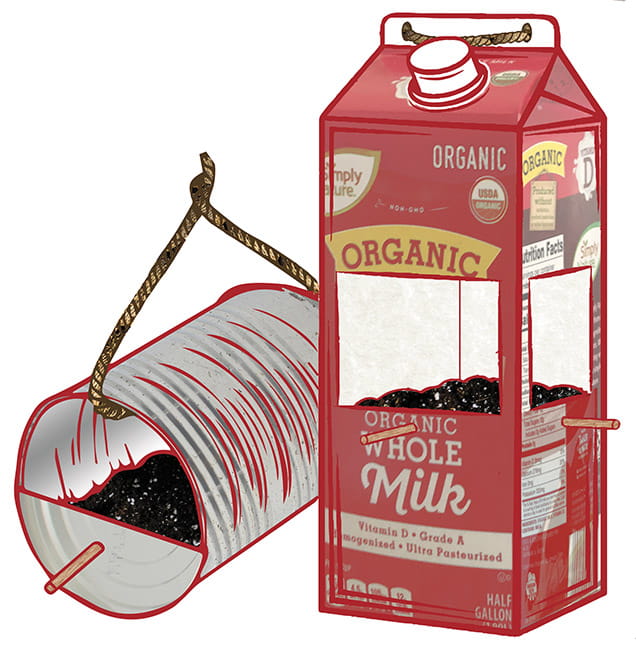
Make a Bird Feeder
You can reuse many household materials to build a cute and useful bird feeder! Check out your recycling bin for a coffee can or milk carton. Then plan out and craft a bird feeder for your outdoor space.
Activities for the Fall Season
-
Apple Stamps
The fall is known for apples. Apples are fruits that come from an apple tree, Malus domestica. There are tons of fall activities that you can do with an apple, such as picking them, eating them or cooking with them. But can you create art with them? Try our apple stamping activity to see what you can create.
Download the Pdf -
Bird Blockers
Many species of birds migrate through our local area during the fall heading to their winter homes in the south. Window and door glass pose a problem for birds because they reflect trees, foliage and sky, which the birds find inviting. Having objects to break up the appearance of a clear flight path on your windows might save many birds.
Download the pdf -
Daylight Measuring
Before clocks, there were sundials. Sundials use a stick or rod to measure the movement of the sun through the day to tell the time. However, fall is a season of change. Animals migrate, leaves fall and the days change. As the Northern Hemisphere, or top half of the earth, begins to shift to winter, the days grow colder, but also shorter. Considering this, how accurate are sundials? Let us find out.
Download the pdf -
Gourd Growing Guide
Gourds are flowering plant species that grow fruit with hard exteriors. This group is one of the earliest domesticated plant types. Gourds have been used for food, tools or even musical instruments. Pumpkins are the most commonly known gourd in the United States due to Halloween traditions. Here we will explore what it takes to grow pumpkins and give advice on how to grow other gourds at well.
Download the Pdf -
Leaf Pressing
The Academy has a large Herbarium of preserved plant specimens. Many are dried to preserve their structure and prevent decay so they can be studied in the future. We can also do a version of this at home by pressing leaves. These leaves can be the start of a collection, used in decoration or fulfill any number of other uses.
Download the Pdf -
Migration Station
Migration is a journey that all animal groups undertake to avoid a climate’s harsh season, find food or even go to a designated mating area. Birds, mammals, reptiles, amphibians and even fish take part in this annual event in some way, traveling short or long distances for an ideal area that better suits their needs. Here, in the Mid-Atlantic Region, many species of birds will stop to eat on the way to their winter homes. To assist them, this Science From Home gives you instructions to make a temporary feeder for the fall season.
Download the Pdf
More activities!
-
Animal Superhero Strength Test
Can you jump as far as a puma or see as far as an owl? Could you compete against the world’s fastest or largest animals? Test your own strength, sight and speed against the abilities of nature’s own superheroes using these easy steps.
Download the PDF -
Balloon Blowing Bottle
Get all the fun of a “volcano” with none of the mess!
Download the PDF -
Magical Moving Milk
Milk is mostly water but it also contains vitamins, minerals, proteins and tiny droplets of fat suspended in solution. Fats and proteins are sensitive to changes in the surrounding solution (the milk). Make magic at home using milk and a little bit of chemistry.
Download the PDF -
Nature Scavenger Hunt
How many things can you find on a walk near your home? Each time you find one, record what you saw in the box with a drawing, a few words or your impressions of the item itself.
Download the PDF -
Shiny Pennies
Use tarnished pennies and a few common household products for this fun chemistry experiment!
Download the PDF -
Splitting Ink
Watch how simple chemistry turns colors into motion as ink splits and spreads, revealing the unexpected right before your eyes.
Download the PDF
Educator Resources
The Academy is excited to offer lessons on water, climate, evolution, biodiversity and extinction for students in grades kindergarten through 12. We have included some of our most recent research with video segments in most lesson plans.
Teachers, these lessons can enhance your classroom curriculum with activities and videos that you can share with your students, and all lessons follow Pennsylvania Academic State Standards and Next Generation Science Standards.


