Drexel’s Environmental Collaboratory Will Solve Environmental Problems With a Community-Driven and Justice-Centered Approach
Journal

Written on: February 10, 2022
Drexel University, in partnership with the Academy of Natural Sciences of Drexel University, has launched a new platform, The Environmental Collaboratory, focused on climate change, environmental justice and human wellbeing. Building on its comprehensive research expertise, longstanding relationship with external partners and deep commitment to civic engagement, Drexel and the Academy will bring together faculty, staff, students, industry partners and the public sector to pursue transdisciplinary, community-based solutions to environmental problems.
The Environmental Collaboratory will support integrated approaches between the often-disparate fields of finance, entrepreneurship, engineering, business, law, policy, public health, medicine, data and information technology, history, infrastructure design and management and civil and human rights.
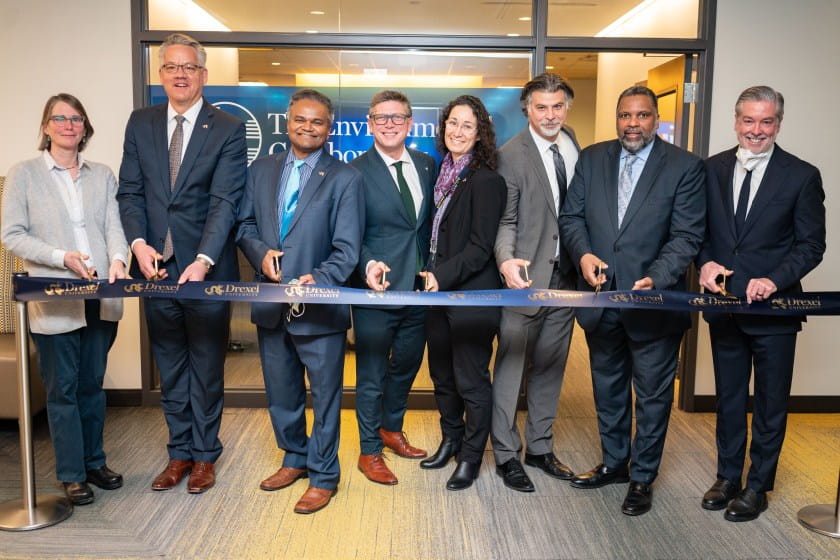
The grand opening of The Environmental Collaboratory. Photo by Shira Yudkoff Photography
Vice Provost and Executive Director Mathy Vathanaraj Stanislaus, formerly of the World Economic Forum and a senior official in the Obama administration, will lead The Environmental Collaboratory. Stanislaus’ scholarship focuses on climate mitigation and adaptation, the scale-up of clean energy and electric mobility, environmentally just transitions and the power of multi-stakeholder designed solutions.
“The challenges of today – as recently highlighted at the United Nations Climate Change Conference, require all of us to work together in fusing our collective expertise, networks and intergenerational insights to create implementable equitable solutions that work on the ground,” Stanislaus said.
“The Climate Conference’s focus on climate justice, just transition, community leadership in driving solutions and the leadership role of young people, reinforces the value of The Environmental Collaboratory. I am honored to help realize this with the leaders of today and tomorrow – our students, the deep expertise of our faculty and researchers and community partners.”
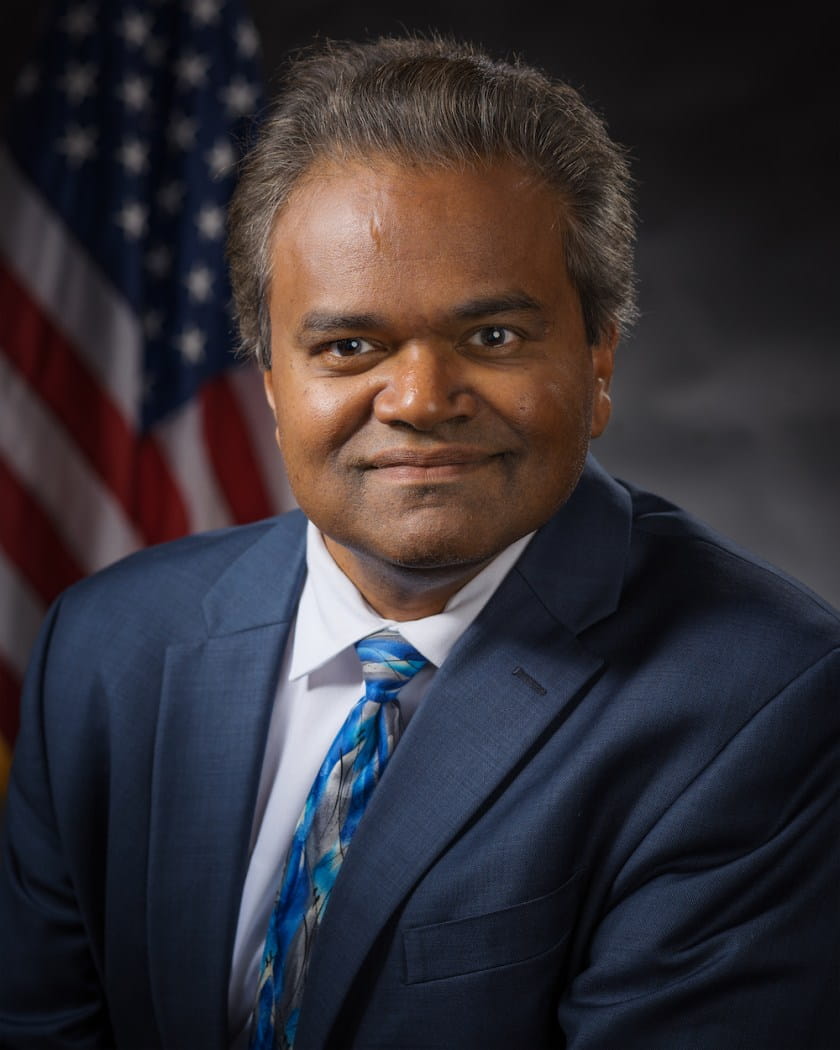
Vice Provost and Executive Director Mathy Vathanaraj Stanislaus will lead The Environmental Collaboratory.
The Environmental Collaboratory serves an important and lead role in the advancement of the Drexel 2030 Strategic Plan’s vision to design the future through the innovative integration of education, scholarship, diverse partnerships, and our global community. The mission of The Environmental Collaboratory is based around three key areas: use-inspired research, social justice-driven civic engagement and community building.
- User-Inspired Research: initiates, facilitates and promotes multidisciplinary teams to help advance user-inspired research for the creation of novel solutions to real-world environmental problems. Faculty, staff and students collaborate with external groups in mutually beneficial partnerships that are grounded in scholarship and consistent with Drexel and the Academy’s roles and missions.
- Civic Engagement: identifies research questions in reciprocal partnerships with communities; engages communities in the research process; devises, incubates and delivers implementation strategies with communities; shares outcomes with a wider audience; shapes beliefs and values through public programs and campaigns; and erodes the power-dynamic that commonly characterizes the relationship between “academia” and “community.”
- Community Building: builds a community at Drexel, acting as a place for interested faculty, staff and students to gather, connect and engage with these issues and our communities.
One of the first projects of The Environmental Collaboratory, supported by the inaugural Glenmede Environmental Collaboratory Research Fund, will be an assessment of progress and actions needed to reduce lead poisoning in West Philadelphia. Studies to date have found that while lead poisoning is declining in some areas of Philadelphia, rates remain high in the Overbrook area of West Philadelphia. Stepfanie A. Kroll, PhD, assistant research professor in the College of Arts and Sciences and watershed ecology section lead at the Academy, will collaborate with Jerome Shabazz, the executive director of the Overbrook Environmental Education Center, to help understand which practices have led to declines in blood lead level (BLL) concentrations in other areas.

Glenmede oversees $43.5 billion in assets under management for Private Wealth, Endowment & Foundation, and Investment Management clients from its headquarters in Philadelphia as well as offices in Ohio, Delaware, Florida, New Jersey, New York, Pittsburgh, and Washington DC. Glenmede works with high-net-worth individuals, families, family offices, endowments, foundations, and institutional clients.
“We are thrilled to partner with Drexel to launch the Glenmede Environmental Collaboratory Research Fund, seeking to effect change on environmental issues right here in our backyard,” said Mark Hays, director of Sustainable & Impact Investing at Glenmede. “We believe this year’s project’s focus on reducing lead poisoning in West Philadelphia will bring awareness and deliver scalable solutions into an issue with significant effects on our environment and our children’s health.”
By Emily Storz, Senior News Manager, Humanities, Social & Environmental Sciences, Office of University Communications


