Meet Our New VP of Community Learning
Journal
Written on: April 12, 2022
Maurice Baynard likes to connect with people — in a big way. “My mom used to say ‘two heads are always better than one.’”
As the Academy’s first Vice President of Community Learning, Baynard’s background and expertise mesh perfectly with his new job of developing a community-centered and impact-focused approach to creating Academy learning programs onsite, offsite and online. He brings thought leadership to the position, specifically around innovation in informal learning and the role of organizations in community science.
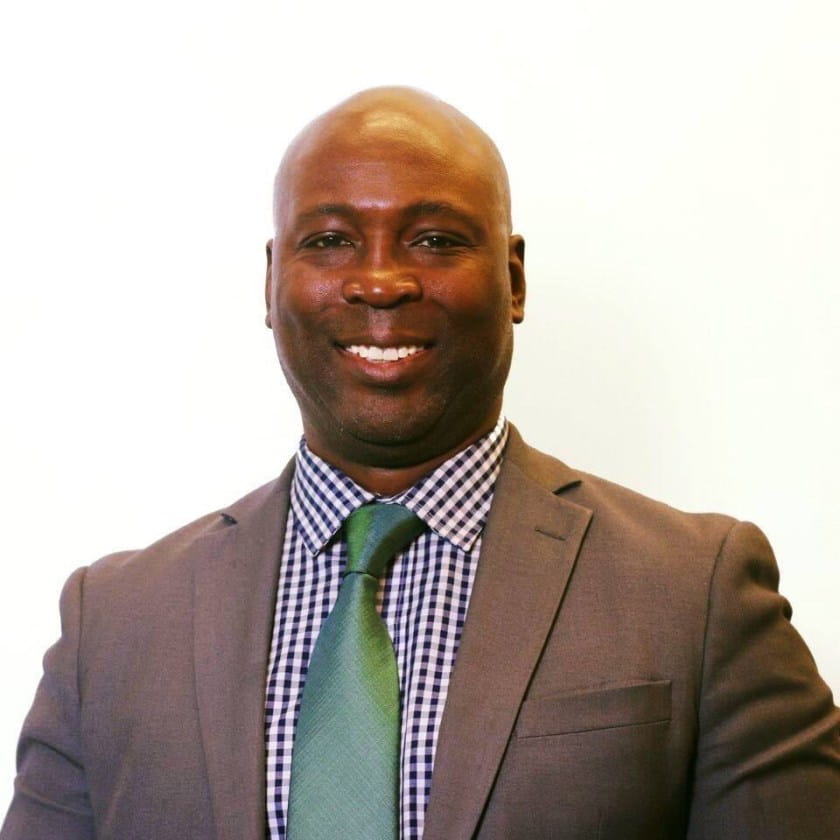
Maurice Baynard is the Academy’s new Vice President for Community Learning
Baynard has more than 15 years of higher education experience and comes to the Academy from the University of the Arts, where he was the first Director of Diversity, Equity and Inclusion. He has focused much of his career on research, secondary, college and graduate level science instruction, and developing programs in STEM for learners of all ages and abilities.
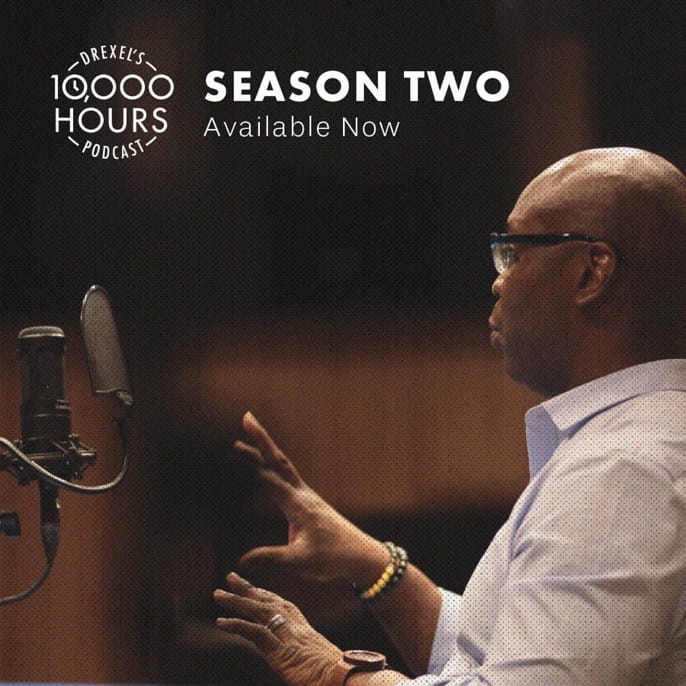
His research interests have included infectious diseases, cell biology, behavioral psychology, neuroscience, sleep physiology and circadian rhythmicity. He has led medical projects in rural West Africa and developed biology curricula for Swarthmore College’s Upward Bound program and Temple University’s Pan-African Studies Community Education Program. He is also the creator and host of Drexel University’s “10,000 Hours” podcast and co-founder of the Broadside Collective.
In introducing Baynard to the staff, Academy President Scott Cooper said: “Maurice brings a passionate commitment to the fundamental belief that diversity and inclusion generate better ideas, inspire creativity, and are essential to building a positive workplace so that in time the Academy can become an institution that is of, by and for all Philadelphians.”
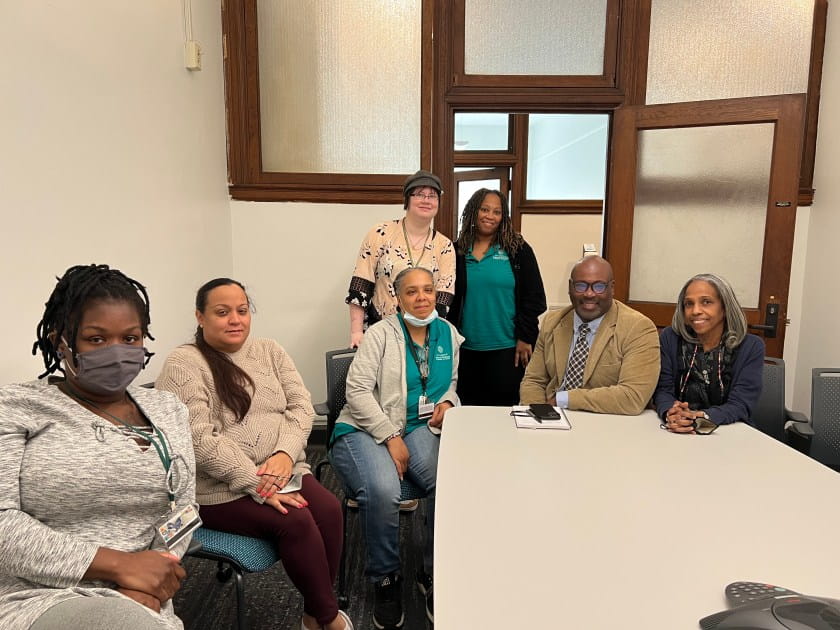
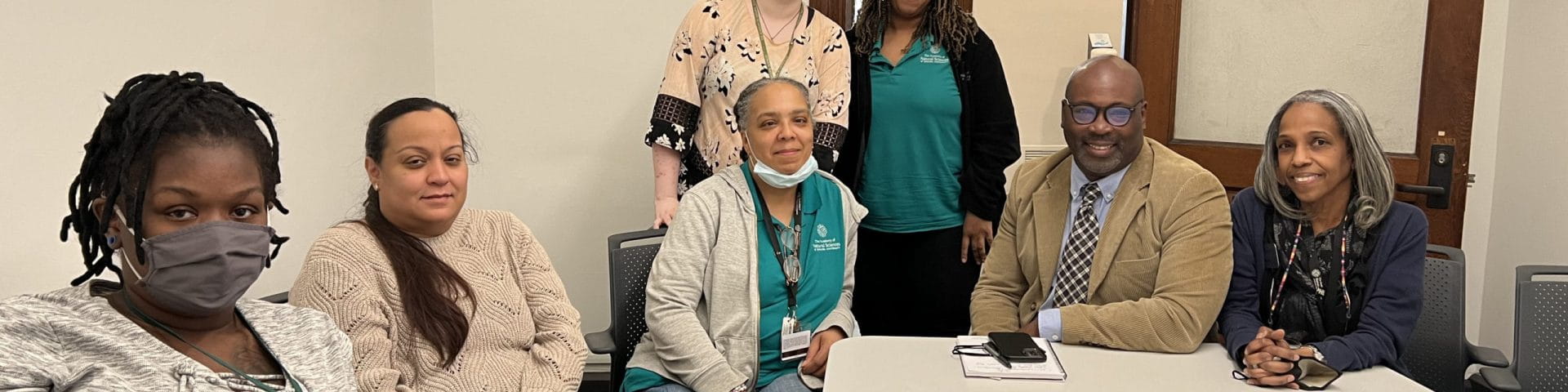
Maurice meets the Academy’s Visitor Services staff. Photo by Marina McDougall
Let’s meet him:
Why did you choose the Academy?
In some ways, the Academy chose me. I attended grade school blocks away at (Albert M.) Greenfield (Elementary School) and spent my youthful days of wonder walking the halls of the Academy, peering into the exhibits. In high school I participated in extracurricular STEM enrichment programs, and I understand how invaluable these early exposures are in developing a life dedicated to science. I’ve spent a career in laboratories, lecture halls and building programs to increase the flow of great and curious minds in the playground-to-PhD pipeline. The Academy’s Community Learning Division offers me the opportunity to bring all these experiences and the skills I developed to bear with a single amazing team of folks. Quite simply, this is the opportunity of a lifetime.
You have extensive ties to the Philadelphia STEM community on so many levels. How will our communities benefit?
The global effects of the changing climate are well documented and have led to an international focus on the causes, exacerbations and potential mitigating strategies to combat the worst and most immediate outcomes. Despite the global implications there exists a failure to recognize and respond to evidence that these changes disproportionately affect communities of racial, ethnic and social minorities, Indigenous peoples, and the poor. Disadvantages and discrimination among these groups result in even greater negative impacts within their communities.
The Academy is poised to:
- foster collaboration among researchers and projects currently active in the region,
- increase the numbers of thinkers from various communities in the climate considerations,
- highlight the work of colleges, universities and secondary schools in creatively engaging students to learn about and participate in climate-related research,
- highlight outstanding projects that exemplify an inclusive, cross-disciplinary and multi-tiered approach to climate research.
How do you plan to apply your passion and commitment to diversity, equity and inclusion?
The Academy strives to be a learning environment and institution of inquiry where all members of the community have full access to the knowledge and research that address our collective vital concerns, as well as illuminate the details of our complex environment. Biases, both conscious and unconscious, insularity and silos, and a lack of empathy toward differences erode our core values and commitments and jeopardize our relevance.
To widen our engagement, deepen our impact and enable relevant solutions — each a part of our five-year strategic outcomes — we must:
- learn to lead with listening to those we hope to make our partners,
- seek to continually evaluate our programs to ensure they deliver messaging grounded in critical inquiry relevant to today’s society and its needs,
- invest in and value diversity in people, ideas, perspectives and experiences both within and without the Academy.
None of this is easily done, but as a framework and a starting point, will yield an institution that is transformative in the region and nation.
You’ve hit the ground running in your first 90 days. What are a few projects you’re working on now?
First of all, I’ve been able to get to know the work and the people of the Academy, and I think it’s rare to find you love every conversation you have. The Academy is full of people who are passionate and have such knowledge about what they do every day. This is a great opportunity to build new things, and I’ve been working on a host of projects:
- We’re planning a Black Birding event for later this spring. Black birders are a loosely associated collective, and in the last few years there have been informal gatherings and birding observations up and down the East Coast. Now, we’d love to be the convener of these groups, the place on the East Coast where Black birding lives.
- WINS (Women in Natural Sciences) is our most famous out-of-school program: running for 40 years, 1,000 graduates, 100 percent college participation. We think its story is under told and it’s not made enough of an impact in Philly. We’re planning a formal celebration in September, a mural through a collaborating neighborhood, and looking for more opportunities with our WINS cohorts.
- We’re looking at where community science is best situated, such as the Overbrook Environmental Education Center, and where else to expand to.
- We got a grant to be a part of a heat monitoring study this summer to look at how different parts of the city experience heat. Some neighborhoods can feel 10 degrees warmer.
Is that enough for now?
Um, yes
What do you like to do in your spare time?
I spend a lot of time thinking about and growing out these ideas we’ve just discussed. And I enjoy helping people think through their own ideas. I have a small group that lays out our plans for the year, two years, five years, and we talk to one another and advise on how to move our ideas forward. I like to connect with people. My mom used to say “two heads are better than one.” And I like to read: a real book (in hands) and on my tablet.
What are you reading now?
I like to read many things at once. I’m currently reading “Up South” by Matthew Countryman, about Philadelphia’s history with civil rights and Black power. I learned about it when, as VP, I attended the unveiling of a marker for the 1967 student walk-outs for equality in curriculum. I’m also reading “The Guns of August” by Barbara Tuchman, about the forces that led to World War I. Also, “The Bond King” by Planet Money’s Mary Childs and “The Deliberative Impulse” by Drexel’s own Andrew Smith.
By Carolyn Belardo and Maurice Baynard


