Late Spring Butterfly Guide
Journal
Written on: May 26, 2020
The trees have leafed out and the days are much warmer. The equinox is a couple months past and we are nearing the longest days of the year. As the season continues to change, the types of butterflies we encounter while enjoying the great outdoors changes too. In light of this, it is time for the next installment of the Academy’s Butterfly Guide, which highlights butterflies that can be found in the Philadelphia area during different times of the year. We are delighted to share with you our 11 favorites among the mid to late spring butterflies.
In this issue, we have added information for each species that we didn’t have in the early-spring issue of the butterfly guide:
- Overwintering: You have asked: Where do butterflies go in the winter? We have added a specific category for that information in this guide. Butterflies have different strategies for surviving the cold winter conditions. Although the majority of the butterflies in this guide overwinter in their chrysalis, some hibernate as caterpillars. Others, like the Monarch, fly south as adults to spend the winter in a warmer area with their subsequent generations moving back north and into our area as the weather warms and plants leaf out.
- Size: Fruits are familiar objects and so we decided to use fruit as a way to give you an idea about the size of each butterfly. It is fun to use fruit to portray size because butterflies have some size variations and fruits also have some size variation.
As in the previous guide, the photos of museum specimens in this post were taken by curatorial staff in the Academy’s entomology research collection. The work is part of the Lepidoptera of North America Network (LepNet) initiative to photograph and transcribe the data of 1.7 million moth and butterfly specimen records. The result is a collection of digitized moth and butterfly data that is ready to be used for systematic, ecological, and global change research. The LepNet photos have also been used to calibrate AI moth and butterfly identification. Download and try out the app, “Leps” today! https://leps.fieldguide.ai/
Some of the butterfly species in the early spring guide, like the Cabbage White, Tiger Swallowtail, Comma, Question Mark and Mourning Cloak can also be found now and later in the season, so keep that guide handy. Enjoy this late Spring butterfly guide and let us know if you have seen these butterflies in the comments below.
Dorsal side – top of the butterfly
Ventral side – bottom of the butterfly
1) Black Swallowtail (Papilio polyxenes)
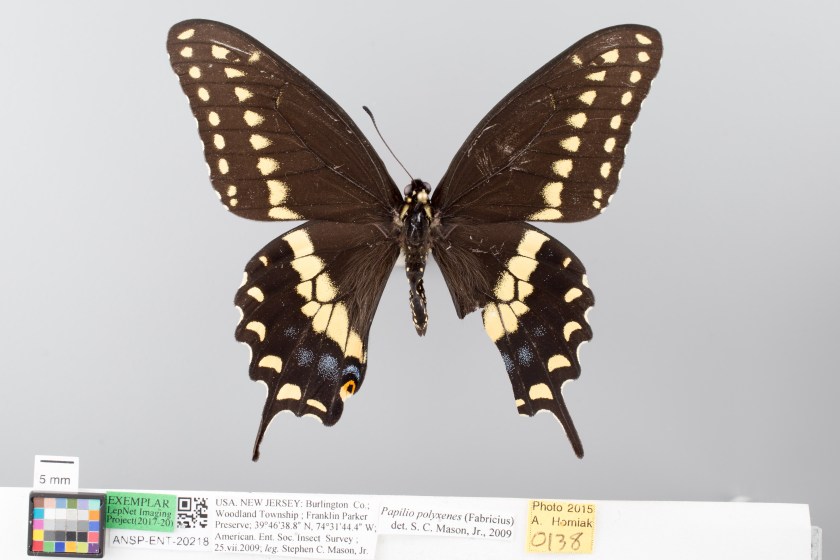
<br>Dorsal view (upperside) of the Black Swallowtail. <br>The photos of scientific specimens include a scale bar for size, a color plate for color calibration, a barcode and human-readable unique code for specimen identification, and a label with collection information such as locality, date, and the collector’s name.
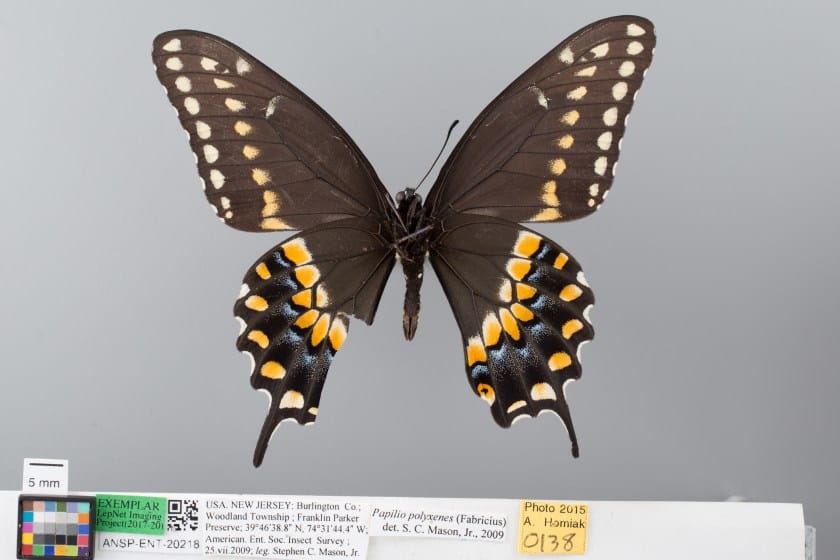
Ventral view (underside) of the Black Swallowtail
Size: Large, around the size of an Orange
Generations per year: Three
Overwinter As: Chrysalis (Pupa)
Interesting Facts:
If you grow parsley or fennel in your yard, you will likely find the caterpillars of this species some time during the growing season, so plant enough for you and for the butterfly!
When touched, the caterpillar may extrude what looks like a pair of soft orange-yellow “horns” behind its head. This forked eversible defensive gland is called the osmeterium. It is a chemical defense common to all members of the swallowtail family. The osmeterium excretes butyric acid (rancid butter smell), as a defense to ward you or any predators away.
Swallowtail butterflies often flutter their wings rapidly when nectaring at a flower.
Did you know that the State Butterfly of New Jersey is the Black Swallowtail?
What do I plant to encourage it? Parsley, fennel, Queen Anne’s Lace and other members of the Carrot family
Where can I see it? Urban and suburban yards. Particularly where host plants are grown.
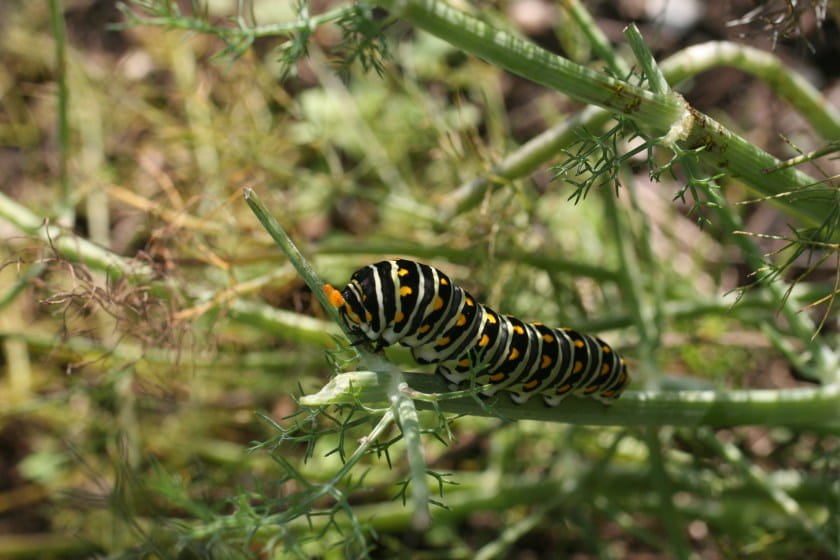
A Black Swallowtail caterpillar with the bright orange osmeterium extruded from behind the head. <br>(photo: Jon Gelhaus)
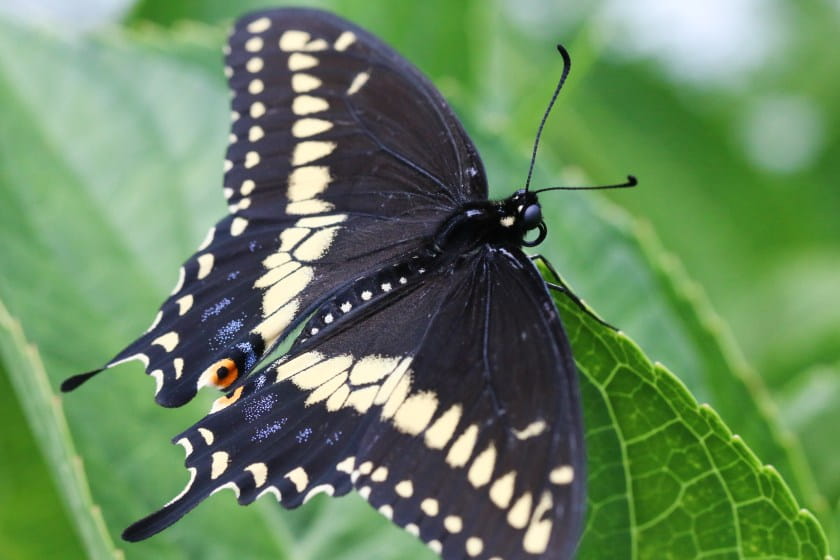
A Black Swallowtail rests on a leaf. Below its eyes is its long proboscis, which is curled up until it is needed for nutrient uptake. <br>(photo: Isa Betancourt)
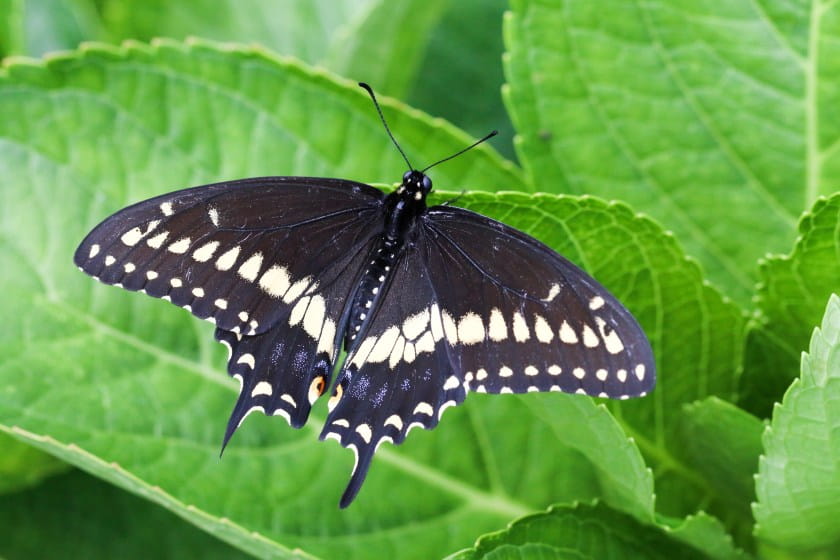
A Black Swallowtail butterfly rests on a leaf. <br>(photo: Isa Betancourt)
2) Spicebush Swallowtail (Papilio troilus)
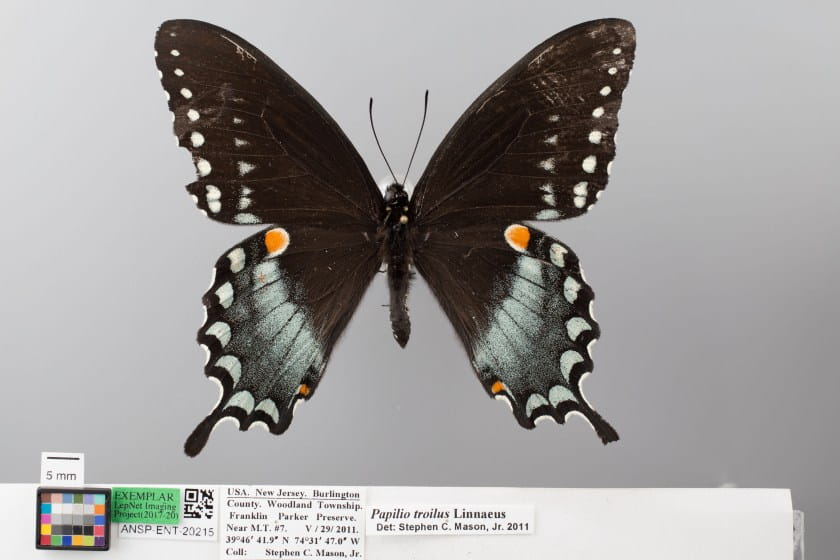
Dorsal view (upperside) of the Spicebush Swallowtail
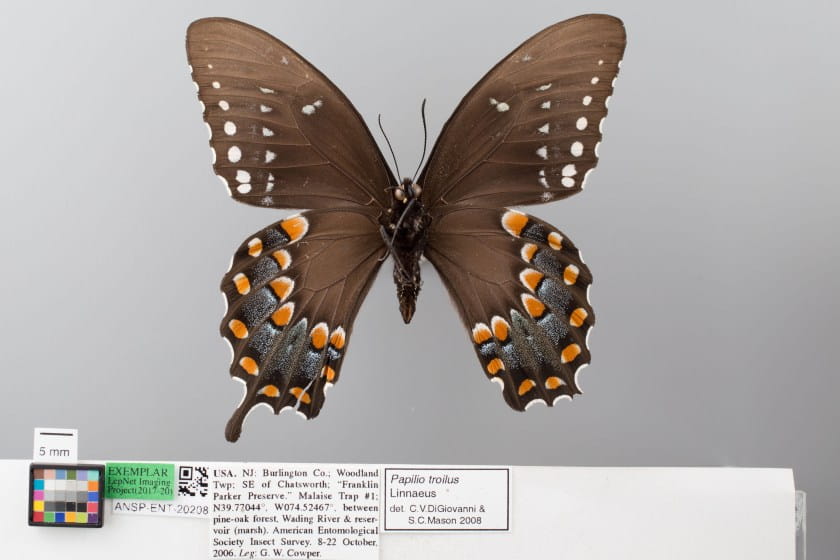
Ventral view (underside) of the Spicebush Swallowtail
Size: Large, around the size of an Orange
Generations per year: Three
Overwinter As: Chrysalis (Pupa)
Interesting Facts:
The dark adult females are thought to mimic the toxic pipevine swallowtail. The first two larval stages escape from predators by resembling a bird dropping, but as the caterpillar grows larger it molts its skin again and eventually becomes green in color with impressive fake eyespots. The caterpillar constructs a series of “homes” out of the leaves it is feeding on, spinning a bridge of silk to fold the leaf edges together. It hides out in this shelter during the day and feeds on its host plant at night.
What do I plant to encourage it? Spicebush (Lindera benzoin) and Sassafras (Sassafras albidum)
Where can I see it? Woodlands with spicebush or sassafras in the understory. For example, the woods behind Pennypack Environmental Center in Philadelphia is a reliable location. They will visit residential gardens.
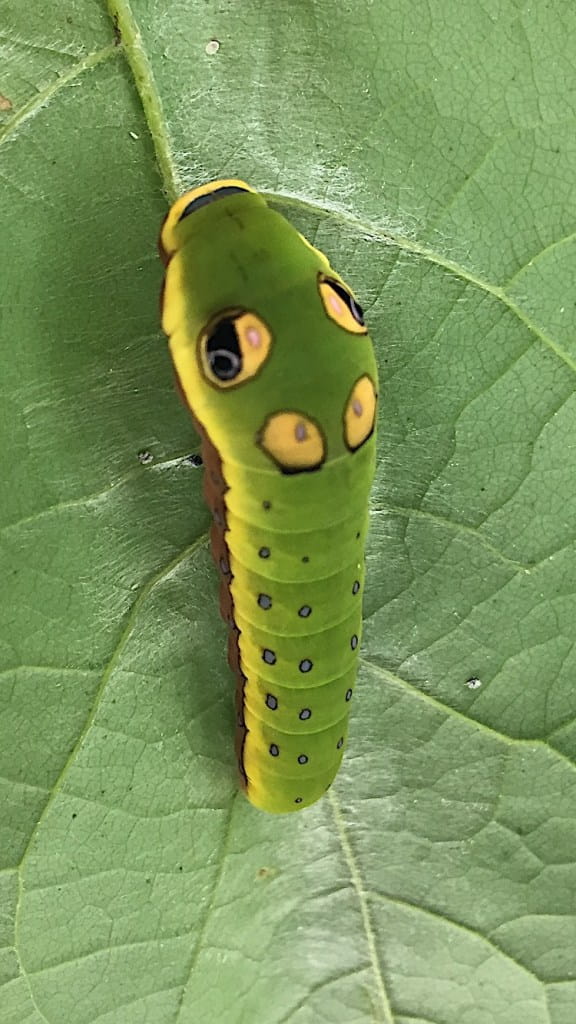
A fully grown caterpillar of the Spicebush Swallowtail. Note the green color with the prominent false eyespots behind the head on the thorax, similar to that seen in the caterpillar of the Tiger Swallowtail. <br>(photo: Jason Weintraub)
3) Clouded Sulphur (Colias philodice)
and 4) Orange Sulphur (Colias eurytheme)
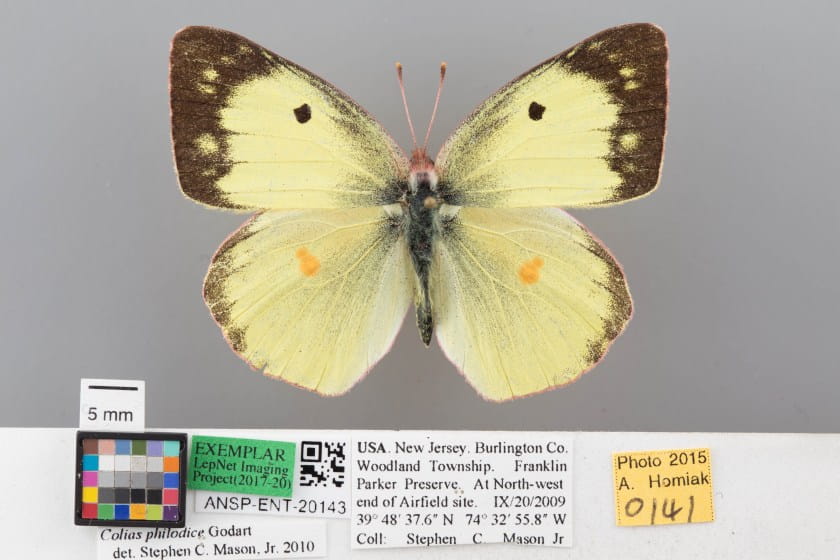
Dorsal view (upperside) of the Clouded Sulphur
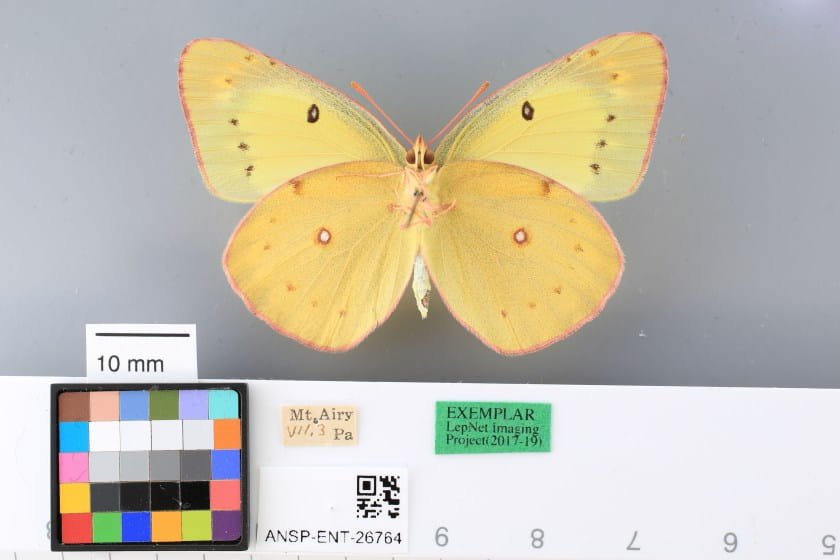
Ventral view (underside) of the Clouded Sulphur <br>
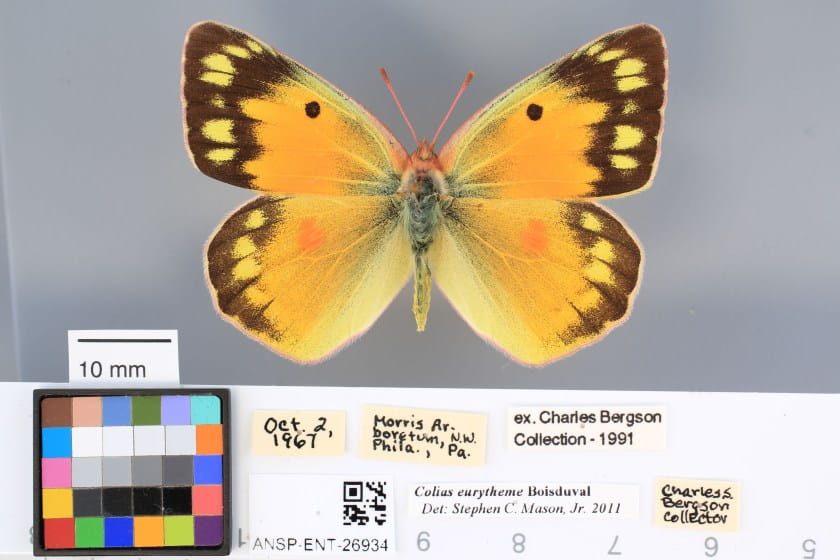
Dorsal view of the Orange Sulphur
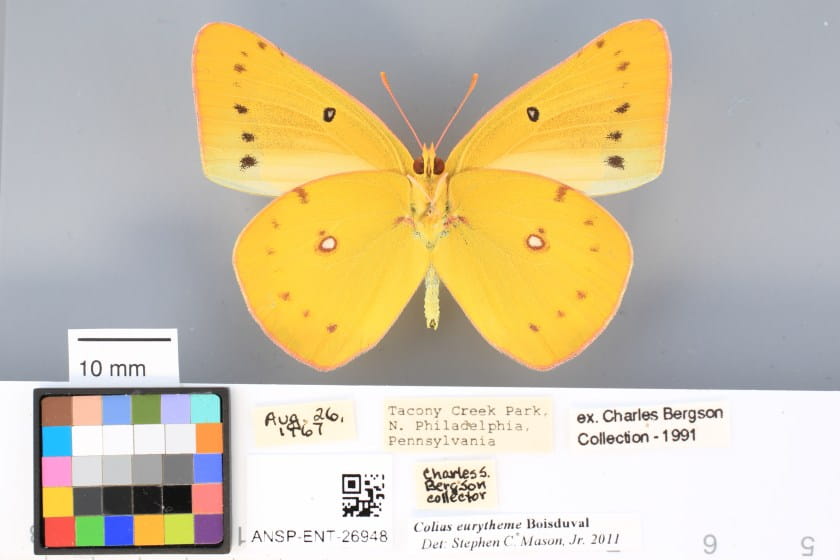
Ventral view of the Orange Sulphur
Size: Medium size, about the size of a Lime
Generations per year: Three to four
Overwinter As: Larva and Chrysalis (Pupa)
Interesting Facts:
These two species are the commonest of the sulphur butterflies in our area. The Orange Sulphur expanded its range from the Southwest US into our area during the mid 1900’s. The Clouded and Orange Sulphurs hybridize making distinguishing these two sulphurs difficult, even for experts. Also, both species show two different color forms of females, with one of these being white, and this white form female may be confused with the common Cabbage White butterfly (covered in our early spring guide).
What do I plant to encourage it? Clovers (Trifolium spp.) and other legumes like alfalfa.
Where can I see it? Open areas, such as meadows and lawns
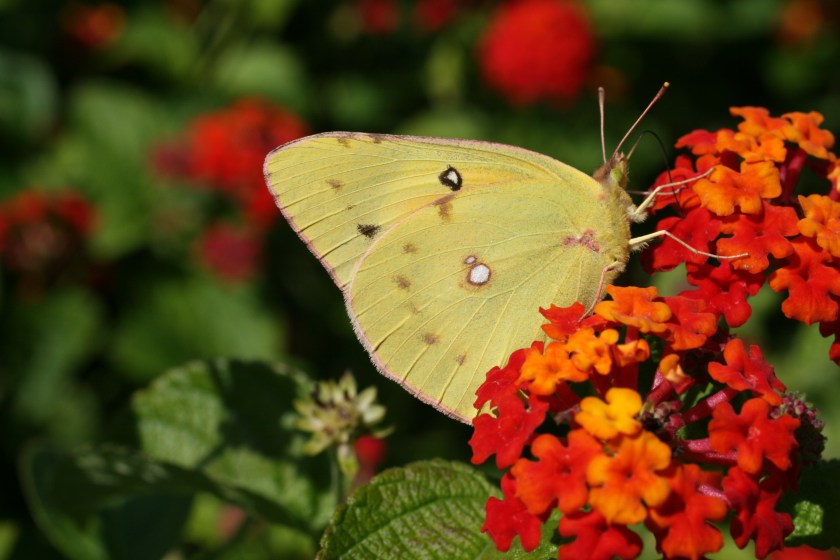
Figure legend: A male Orange Sulphur nectaring on a red Lantana flower. ( photo: Jon Gelhaus)
5) Eastern Tailed-Blue (Cupido comyntas)
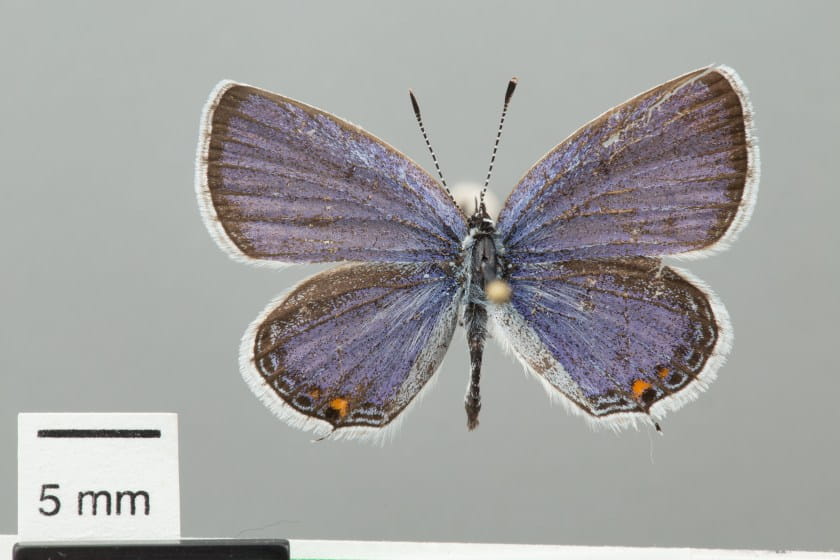
Dorsal view of the Eastern Tailed-Blue .
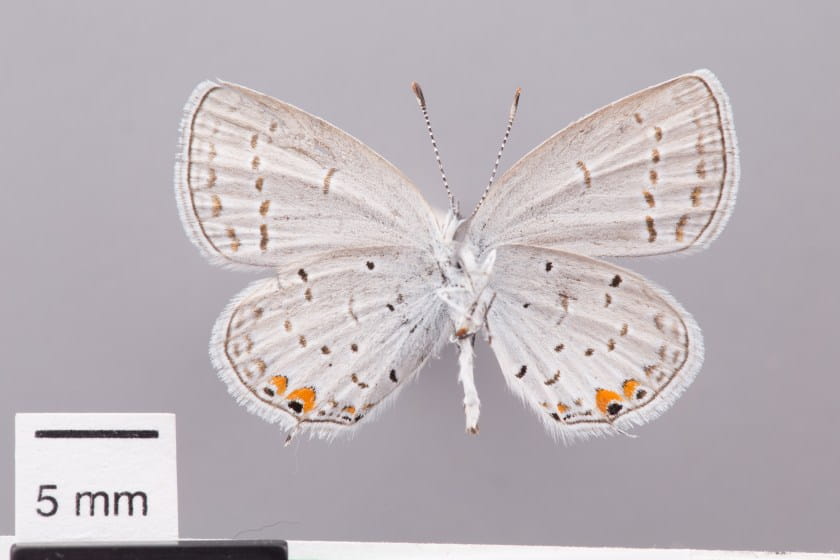
Ventral view of the Eastern Tailed-Blue .
Size: Small, about the size of a Blueberry
Generations per year: Four
Overwinter As: Chrysalis (Pupa)
Interesting Facts:
This is our most often seen of the “blue” butterflies in the spring and summer and it is also one of the smallest. The Eastern Tailed-Blue is active close to the ground, often on lawns with clover. The dorsal or top side of male butterfly’s wings are iridescent blue, which can be observed as a flash of blue in flight or when they are sunning on a leaf.
What do I plant to encourage it? Clovers (Trifolium spp.), alfalfa, crownvetch, and other legumes
Where can I see it? On lawns and meadow-like areas, in suburban and urban settings
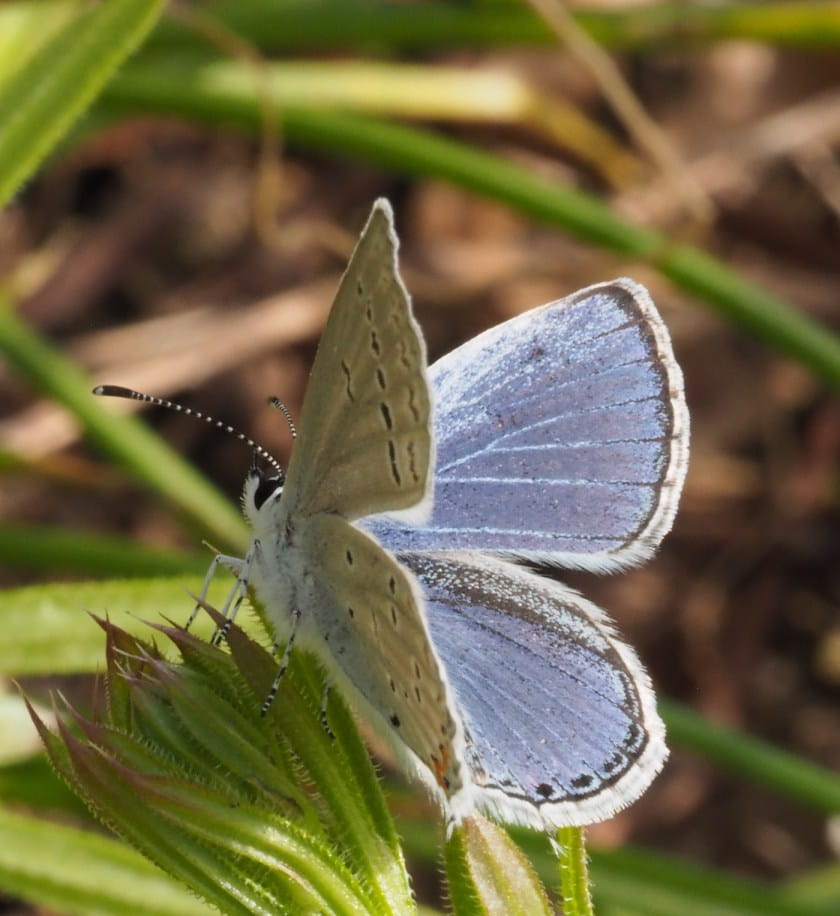
A male Eastern Tailed-Blue displaying the iridescent blue color of the wings. <br>(photo: Jason Weintraub)
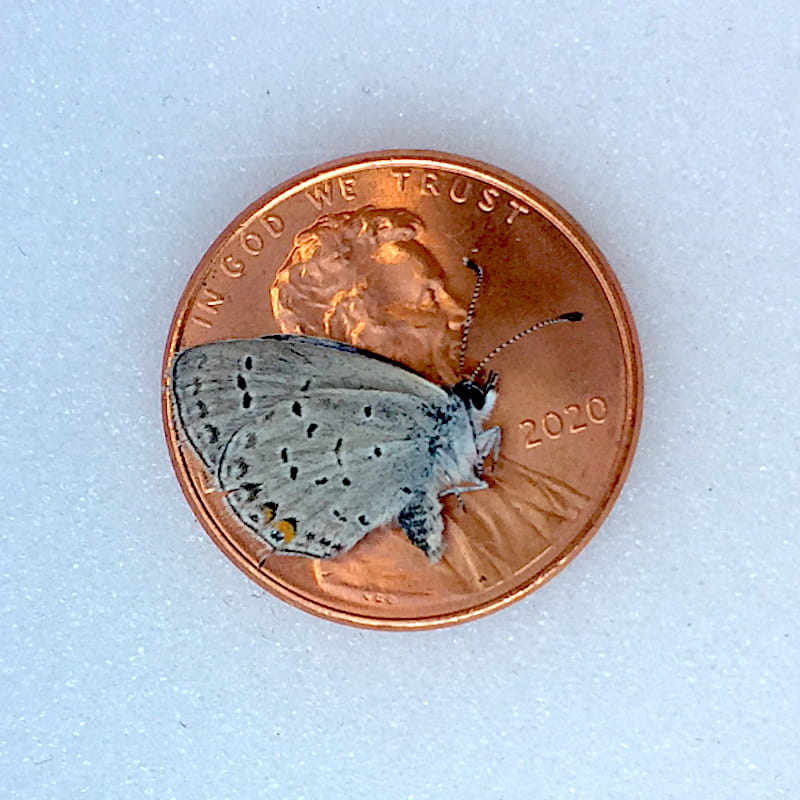
A specimen of the Eastern Tailed-Blue showing size comparison with a penny. This species is the smallest of our local butterflies. (photo: Jason Weintraub)
6) Summer Azure (Celastrina neglecta)
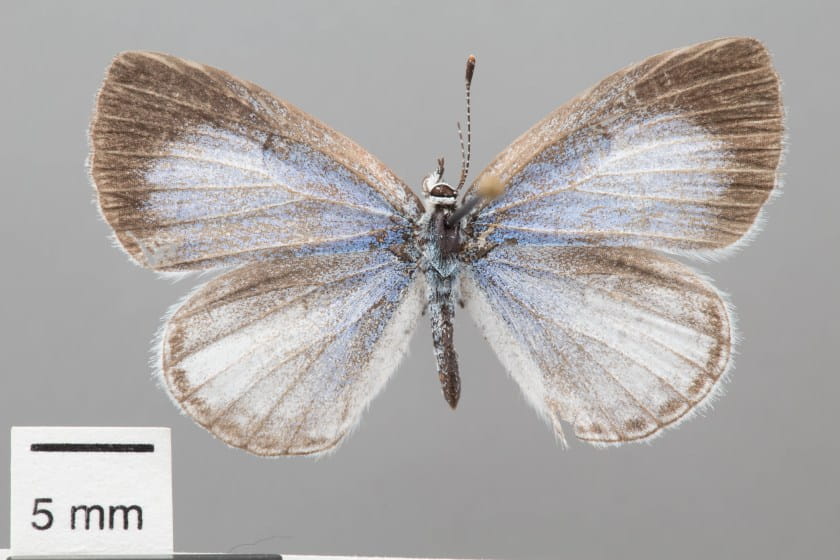
Dorsal view of the Summer Azure.
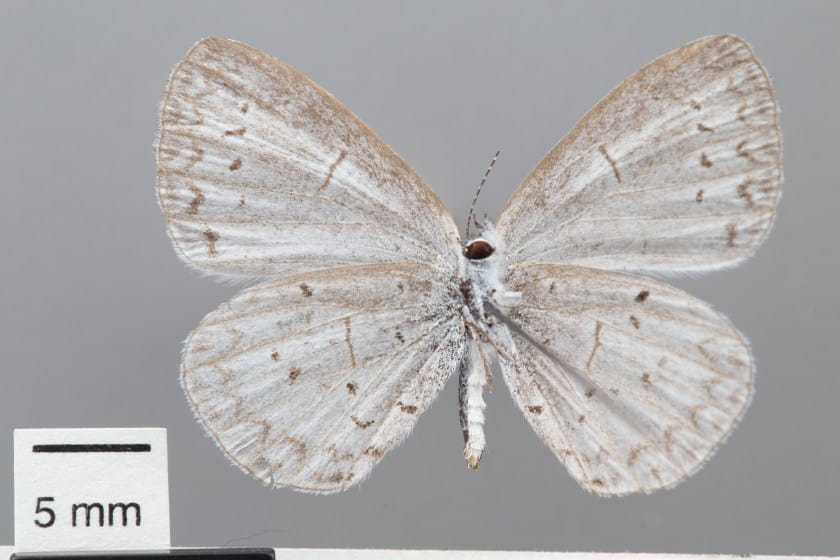
Ventral view of the Summer Azure.
Size: Small, about the size of a Raspberry
Generations per year: Three
Overwinter As: Chrysalis (Pupa)
Interesting Facts:
The Summer Azure is another of the blue butterflies. For many years it was considered as a single Azure species. Recent research has documented that six very similar species had been grouped as Celastrina ladon (scientists call this a species complex). The six species are remarkably similar in morphology but have different flight times as adults and different host plants as larvae. The Summer Azure is the species in this complex that is most likely to be seen in our yards. It is larger and flies higher than the Eastern Tailed-Blue.
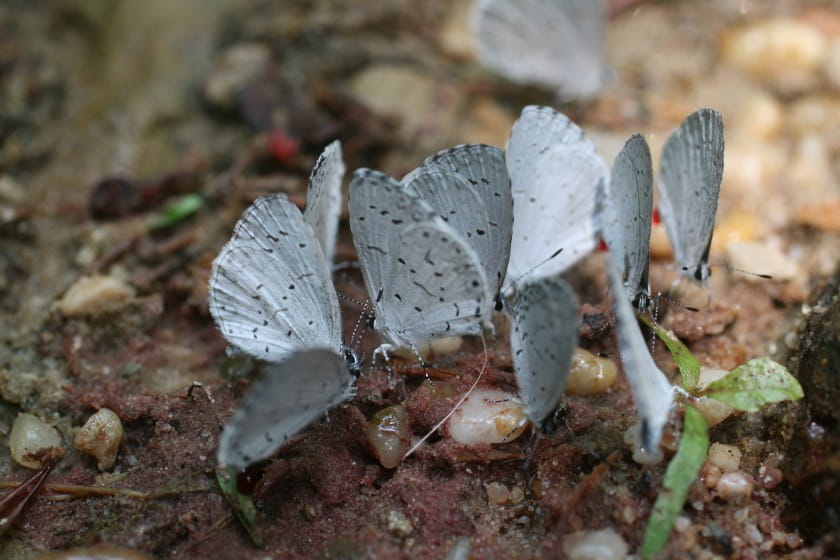
Azures like some other butterflies can be seen in groups “puddling” at damp soil, where the males are imbibing essential nutrients like salt. Try forming a wet puddle in a bare place in your yard to see which butterflies stop for a drink!
What do I plant to encourage it? Floral buds of many different plant species including Dogwood (Cornus spp.) and White Meadowsweet (Spiraea alba)
Where can I see it? Many habitats including parks and gardens.
A group of two species of male Azure butterflies puddling along a damp spot along a streambed. Males imbibe moisture and essential nutrients from damp soil. (photo: Jon Gelhaus)
7) American Snout Butterfly (Libytheana carinenta bachmanii )
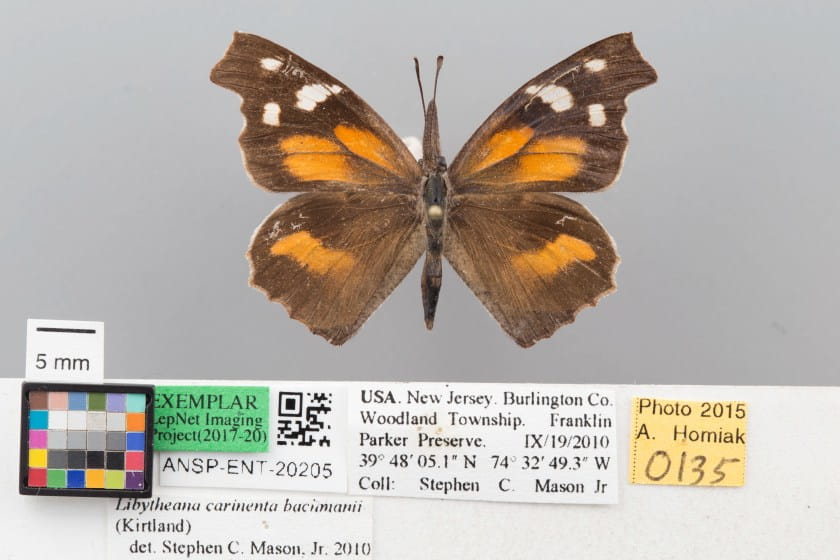
Dorsal view of the American Snout Butterfly.
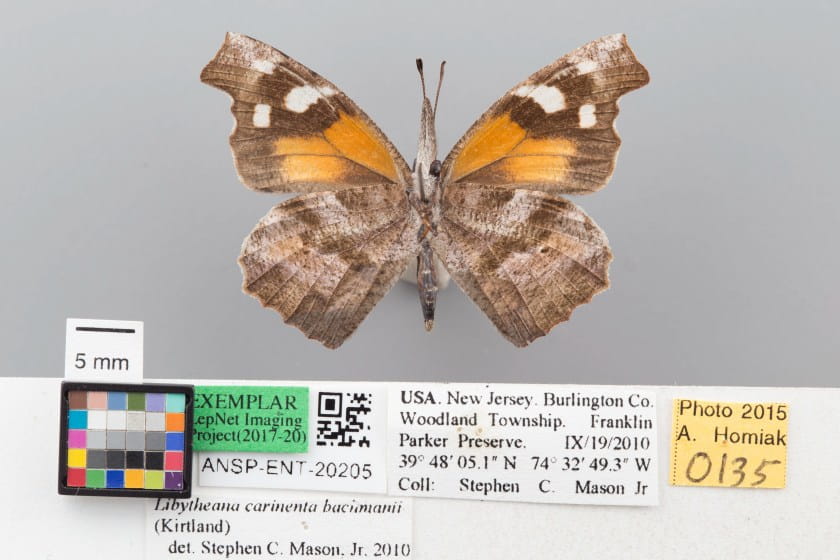
Ventral view of the Painted Lady American Snout Butterfly.
Size: Medium, about the size of a Cherry
Generations per year: Two to three
Overwinter As: Adult in Southeastern U.S. It must repopulate our area every year (adults move northward in the Spring after overwintering).
Interesting Facts:
The Snout Butterfly is so named due to the very long labial palps on their head, which resemble a “nose” or “beak.”
The earliest spring generation moves northward into our region, sometimes as early as Spring. This species, like the Painted Lady (following), is known for large population fluctuations from year to year.
The North American subspecies of the Snout Butterfly was named to honor John Bachman (1790-1874) who was a prominent naturalist and friend of John James Audubon.
What do I plant to encourage it? Hackberry (Celtis spp.)
Where can I see it? This species frequents woodland edges and brushy fields. It may be found in parks and woodlands where Hackberry trees are present.
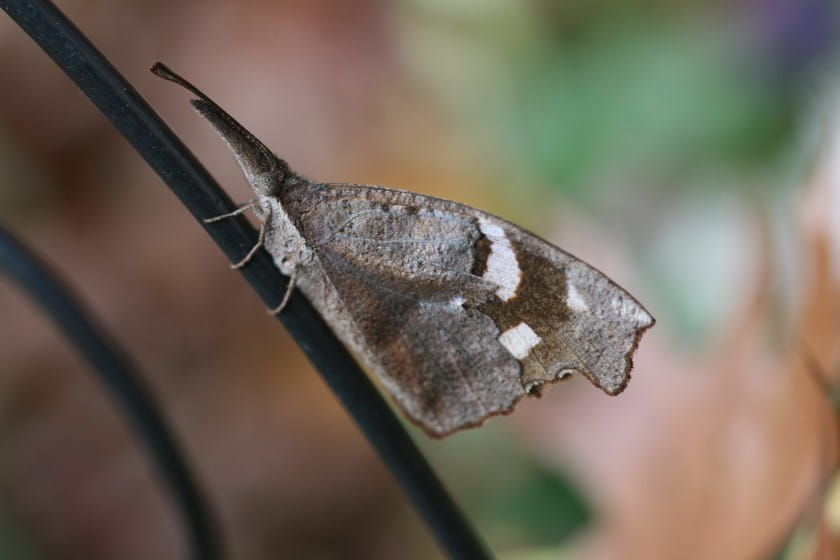
A Snout Butterfly at rest, showing the distinctive snout protruding from the front of the head formed by the extended mouthparts called labial palps. (photo: Jon Gelhaus)
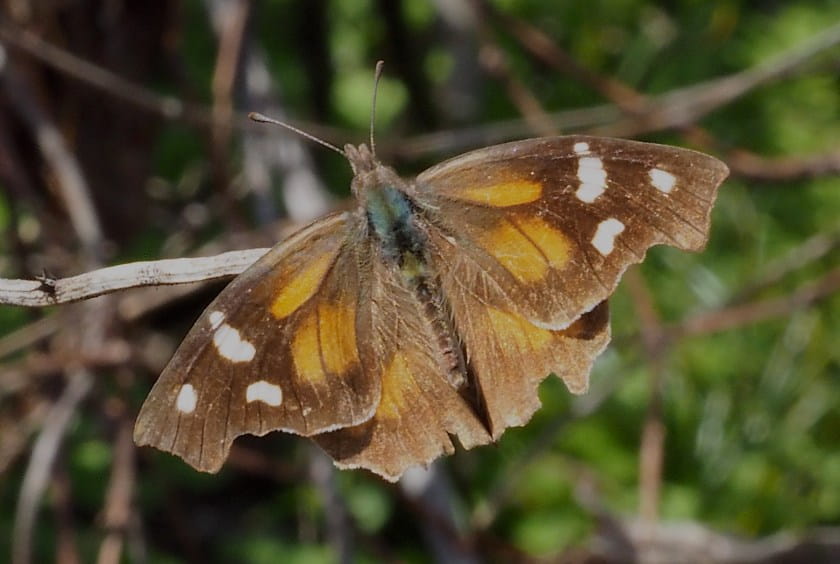
A Snout Butterfly displaying the bright orange-brown markings on the dorsal (upper) surface of the wings. (Jason Weintraub, photo)
8) Painted Lady (Vanessa cardui )
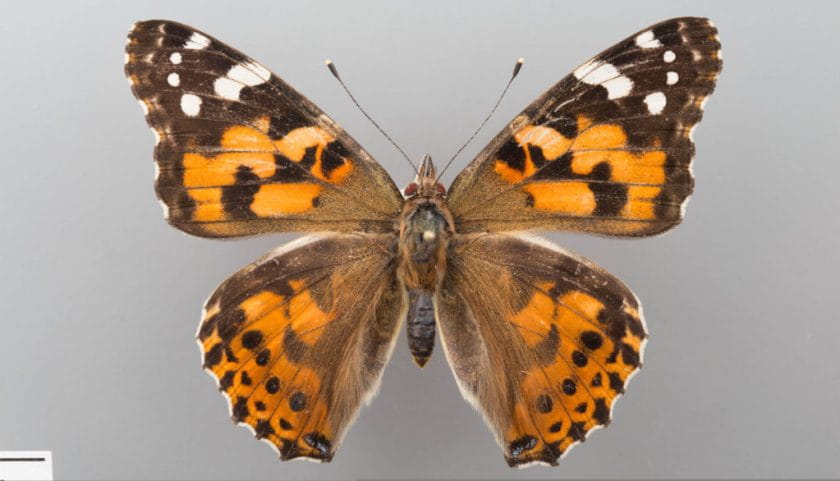
Dorsal view of the Painted Lady.
Size: Large, about the size of a Lime
Generations per year: One to Three (depending on when migrants populate our area)
Overwinter As: Chrysalis (Pupa) but doesn’t overwinter in our area.
Interesting Facts:
This species can vary in abundance from year to year, with occasional population explosions resulting in mass migratory movements and in other years rather rare. It is a common visitor to flowers in the garden,
What do I plant to encourage it? Thistles (Cirsium spp., Carduus spp.), Burdock (Arctium lappa), Borage (Borago officinalis), Mallows (Malva spp.).
Where can I see it? Open meadows.
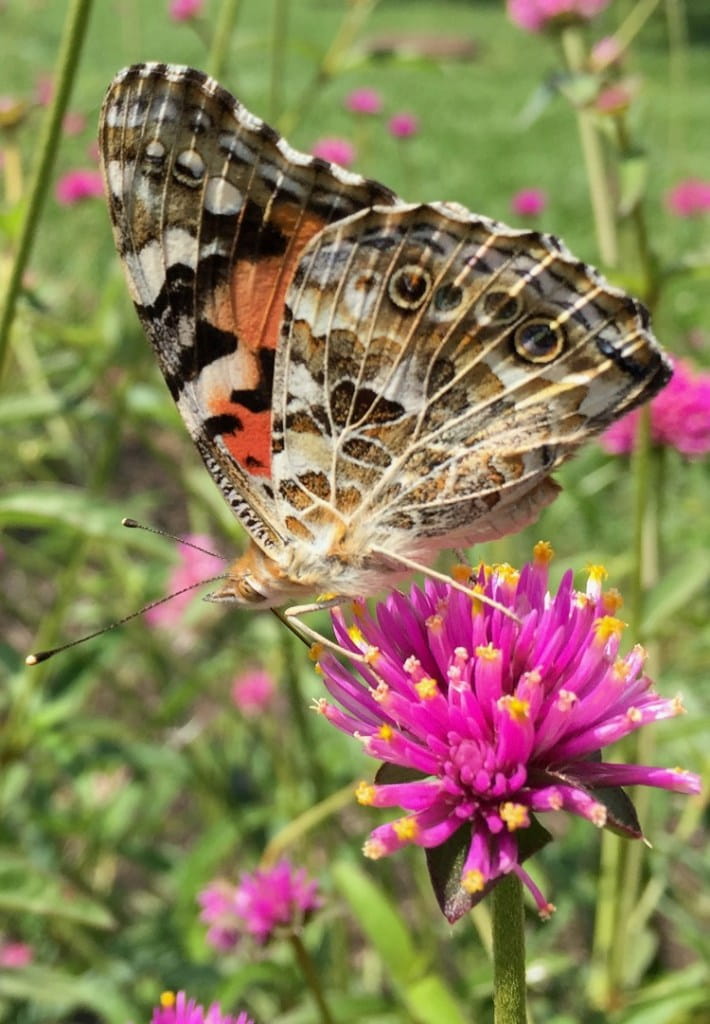
A Painted Lady nectaring on a flower. This adults of this species are regular visitors to flowers in the home garden.<br>(photo: Jason Weintraub)
Skippers
Skippers are a group of Lepidoptera thought by most entomologists to be close relatives of butterflies. While butterfly antennae have a rounded knob/club (or thickening) at the end, the antennae of skippers have a curved knob at the end, sometimes with a very narrow projection beyond the knob to the end of the antenna (the apiculus). Some skippers open their wings flat when perched like Juvenal’s Duskywing, but others open the wings only partially, like the Zabulon Skipper.
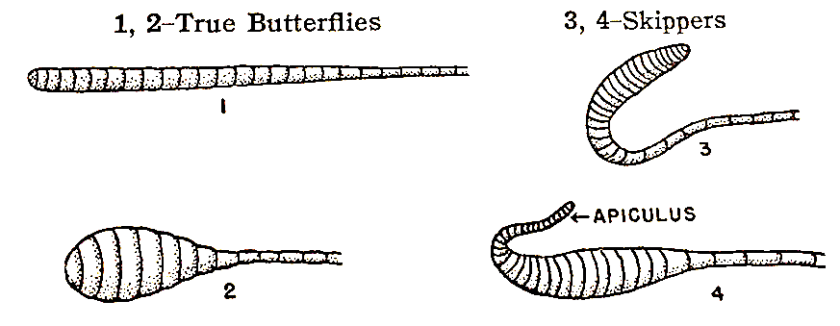
<br><br>Different shapes of the antenna’s “knob” or “club” in Butterflies and Skippers. <br>[after Klots (1951), <em>A Field Guide to the Butterflies.</em>]
Because most skippers are active during the day, they are treated as “honorary butterflies” and are usually included in field guides and popular literature alongside the “true” butterflies.
9) Silver-spotted Skipper (Epargyreus clarus)
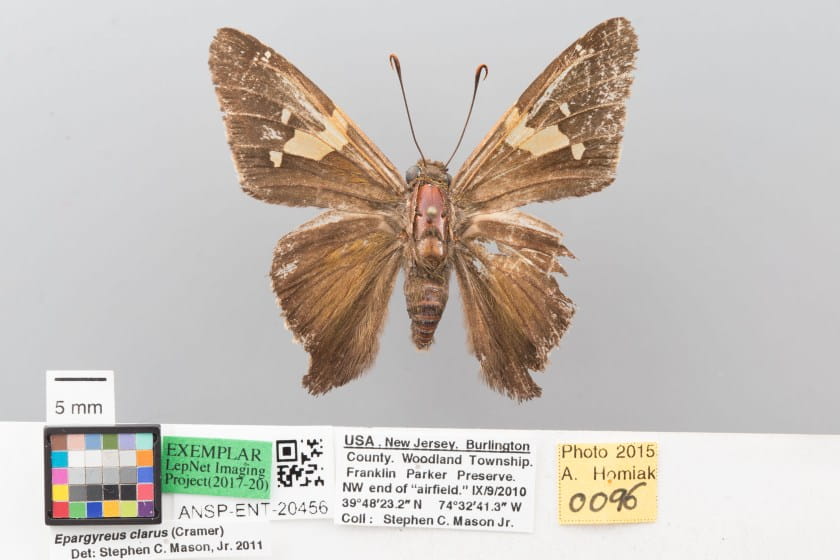
Dorsal view (upperside) of the Silver-spotted Skipper. <br>Not all specimens are in ‘perfect’ condition. This specimen was collected as part of a survey to document the insects in the Franklin Parker Preserve in New Jersey. When projects like this occur, sometimes the only specimen evidence for a particular species will be an older or worn specimen like this one. Butterflies and skippers naturally lose scales and develop tears in the wings as they age.
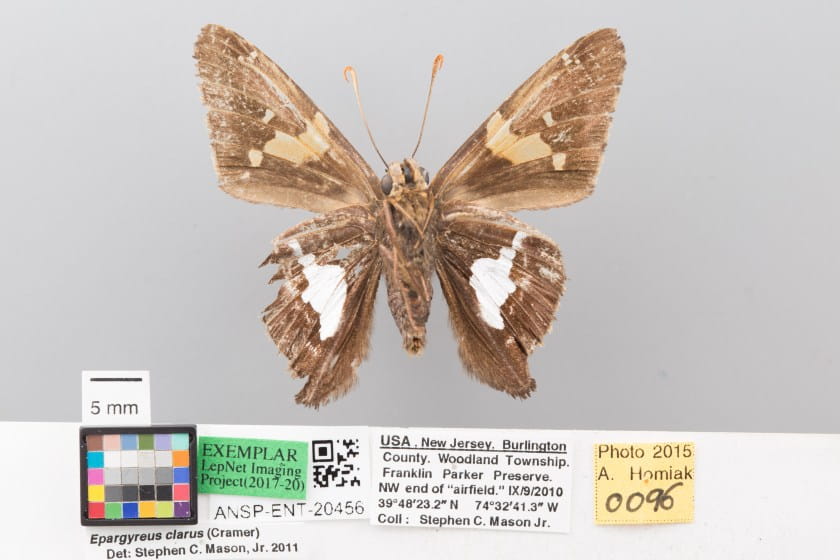
Ventral view of the Silver-spotted Skipper Zabulon Skipper.
Size: Medium, about the size of a Cherry
Generations per year: Three
Overwinter As: Chrysalis (Pupa)
Interesting Facts:
Like many skippers, the male of the Silver-spotted Skipper is territorial. It watches from a perch and flies out to chase away other insects and even human observers. The name refers to a large silvery patch on the underside of each hindwing.
What do I plant to encourage it? Black Locust (Robinia pseudoacacia) and other plants in the Pea family, including ornamental Wisteria in cities and parks.
Where can I see it? Readily visits flowers in gardens
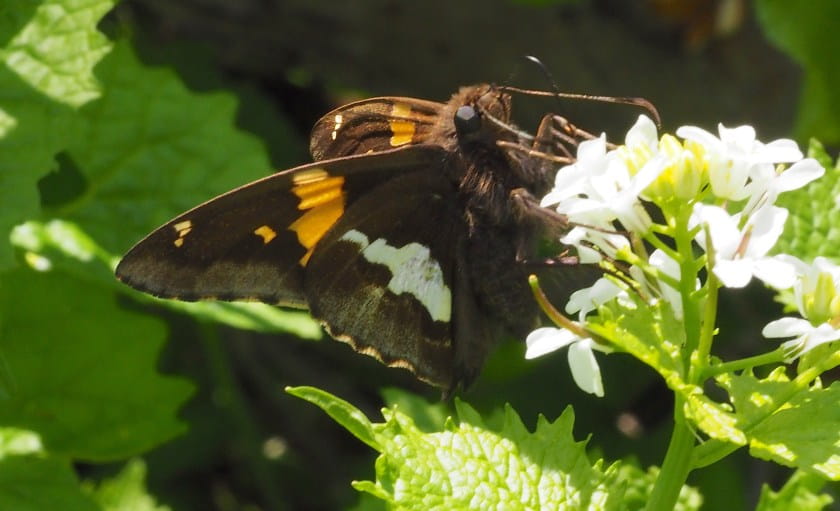
A Silver-spotted Skipper nectaring. Note the curved knob at the end of the antennae which is characteristic of Skippers, and the silvery-white patches on the underside of the hind wings which are characteristic of this species. (Jason Weintraub, photo)
10) Zabulon Skipper (Poanes zabulon)
Size: Small, about the size of a Raspberry
Generations per year: Two
Overwinter As: Partially grown caterpillar (Larva)
Interesting Facts:
The Zabulon Skipper is a strongly sexually dimorphic species, a term that scientists use to indicate that the males and females are quite different in appearance. The males of the Zabulon Skipper are brown with a bright golden patch on the hind wings. The females are overall a chocolate brown color.
What do I plant to encourage it? Native grasses
Where can I see it? Parks and gardens as well as edges of woodlands. They readily visit flowers.
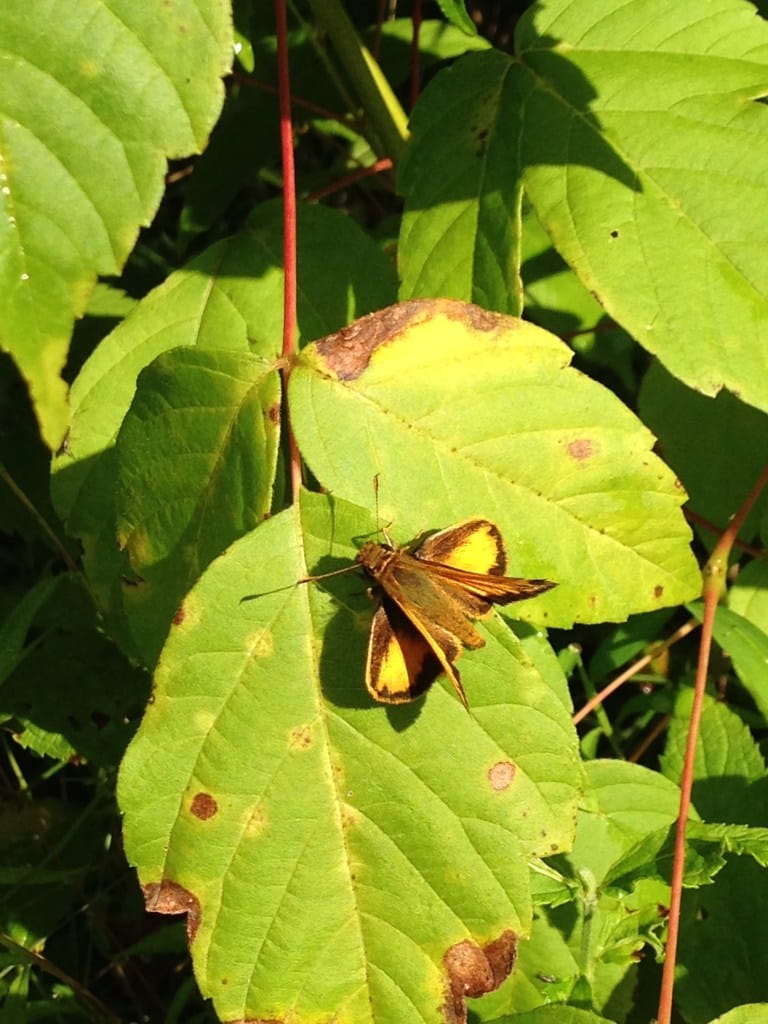
A male Zabulon Skipper displaying the bright yellowish patches on the hind wings. Some skippers like this Zabulon Skipper do not spread their wings flat when displaying, and this behavior can be an easy way to identify it as a skipper. Identifying to species, though, can be challenging for many skippers. <br>(photo: Jon Gelhaus)
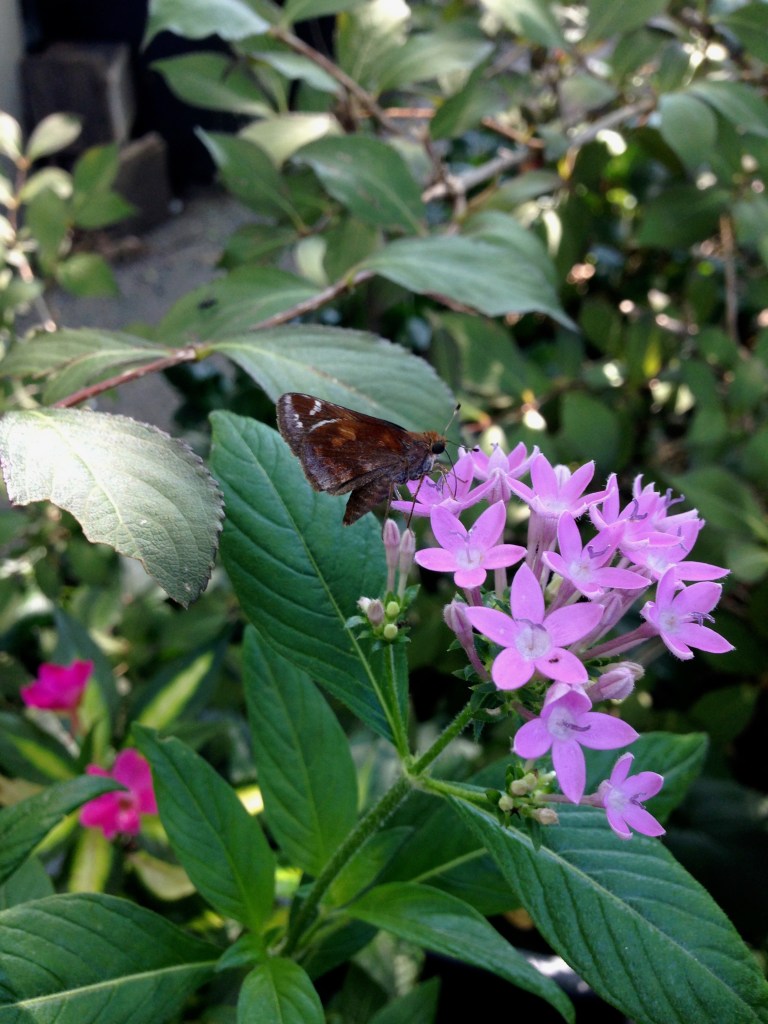
A female Zabulon Skipper nectaring on a Penta flower. This species shows sexual dimorphism with both sexes differently marked on the wings. The female is overall dark brown, and doesn’t show the bright yellow markings seen in the male. (photo: Jon Gelhaus)
11) Juvenal’s Duskywing (Erynnis juvenalis)
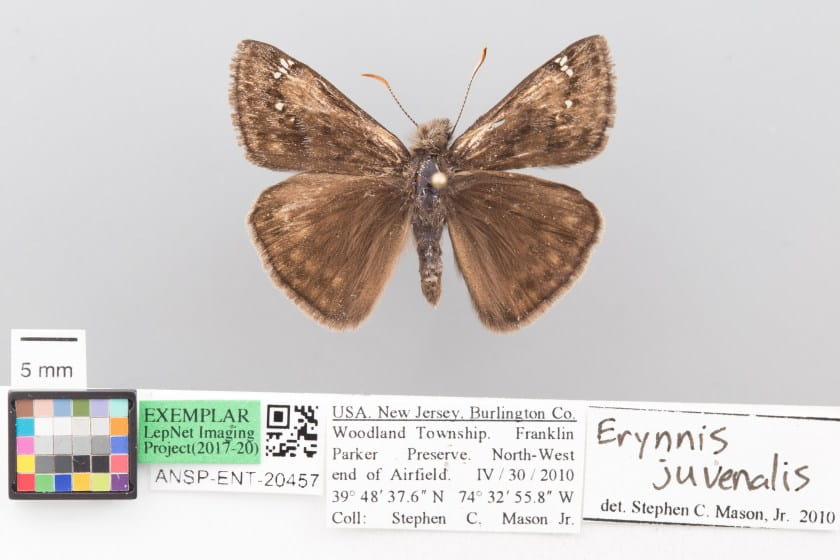
Dorsal view of the Juvenal’s Duskywing.
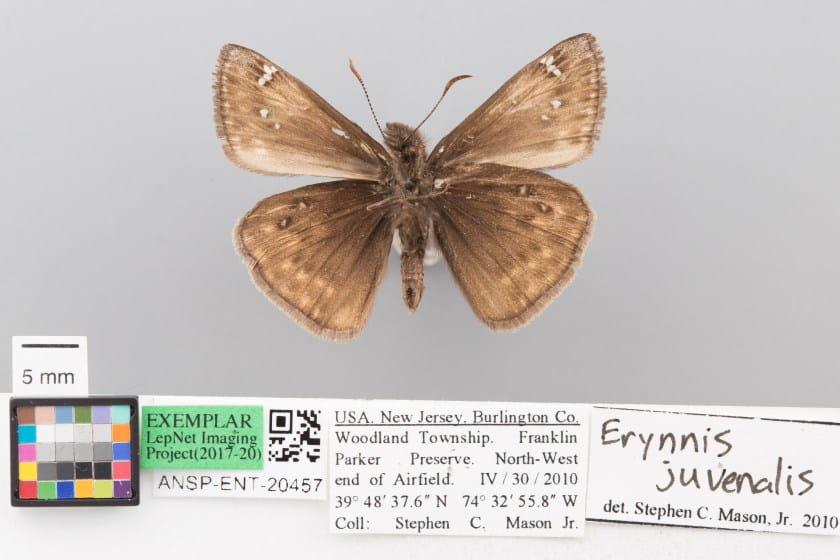
Ventral view of the Juvenal’s Duskywing .
Size: Medium, about the size of a Cherry
Generations per year: One
Overwinter As: Fully grown caterpillar (Larva)
Interesting Facts:
This species belongs to the “spread-wing” group of skippers, which rest with their wings outspread and flat. They often land on the ground, rather than visit flowers. This group contains several species in our area with similar-looking adults that can be hard to identify, particularly if the wings are worn and missing scales.
Several of the duskywings were named after ancient Roman poets like Juvenal.
What do I plant to encourage it? Oaks such as White Oak (Quercus alba) and Red Oak (Quercus rubra).
Where can I see it? Woodlands and woodland edges bordering open fields.
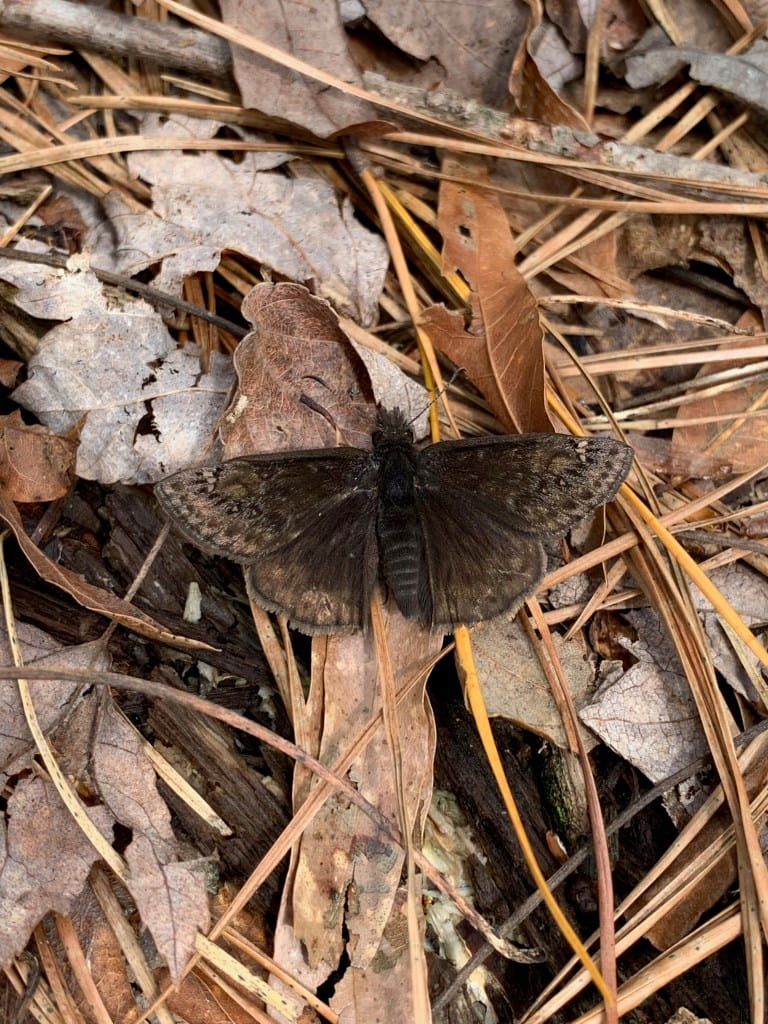
A displaying Juvenal’s Duskywing on a patch of dead leaves on the ground. The wings are held flat, and is found in the “spread-wing” group of Skippers, similar to that behavior seen in many other butterflies. <br>(photo: Jon Gelhaus)
Have you seen these butterflies out and flying yet? Let us know in the comments below.
Additional Remarks and Resources:
If you like photographing butterflies, you see and want some help in identifying, you might enjoy this app for your phone which has a built-in algorithm to identify the species from a photo you submit: iNaturalist https://www.inaturalist.org/
If you want a paper field guide to have around the garden or out on your walk, we recommend this one for this region:
A Field Guide to Eastern Butterflies (Peterson Field Guide Series). By Paul A. Opler In paperback. 512 pp. Houghton Mifflin Harcourt. ISBN: 0395904536
https://smile.amazon.com/Field-Eastern-Butterflies-Peterson-Guides/dp/0395904536
https://www.barnesandnoble.com/w/a-field-guide-to-eastern-butterflies-roger-tory-peterson/1119268694
If you choose to purchase through Amazon, consider purchasing through AmazonSmile. Amazon will donate .5% of your purchase amount to the Academy if you designate us as your preferred charity. Now, we know that .5% doesn’t sound like a lot—but it adds up!
Some references with more information on butterflies for our region include:
For the most recent sightings of butterflies in New Jersey check out the South Jersey Butterfly Project https://sjbutterflies.org/
Butterflies of Pennsylvania: A Field Guide. 2017, by James L. Monroe and David M. Wright. In paperback. https://upittpress.org/books/9780822964551/
Butterflies of New Jersey. 1997. by Michael Gochfeld and Joanna Burger. in paperback. https://www.amazon.com/exec/obidos/ISBN=0813523540/103-2305405-0687859
Butterflies of the East Coast: An Observer’s Guide. 2007. by Rick Cech and Guy Tudor. In paperback. Princeton Univ. Press. https://smile.amazon.com/Butterflies-East-Coast-Observers-Guide/dp/0691090564
Butterflies & Skippers (Lepidoptera: Papilionoidea, Hesperioidea) of the Franklin Parker Preserve, Burlington County, New Jersey. 2015. By Stephen C. Mason Jr. Transactions of the American Entomological Society, 141(3):351-368 download http://taes.entomology-aes.org/modules/articles#/manuscripts
Butterflies and Moths of North America: https://www.butterfliesandmoths.org/
Content provided by Academy Entomologists Isabelle Betancourt, Dr. Jon Gelhaus, Dr. Jason Weintraub
Blog layout: Mike Servedio


