National Climate Assessment: An Inescapable Truth
Journal
Written on: November 27, 2018
A new federal report on the effects of climate change, including in Philadelphia, describes a severe, rapidly unfolding problem with high potential for future disaster.
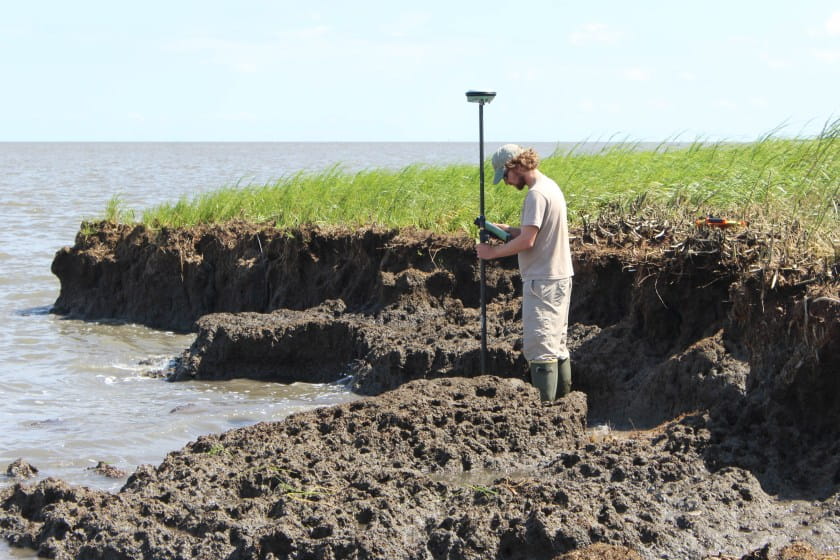
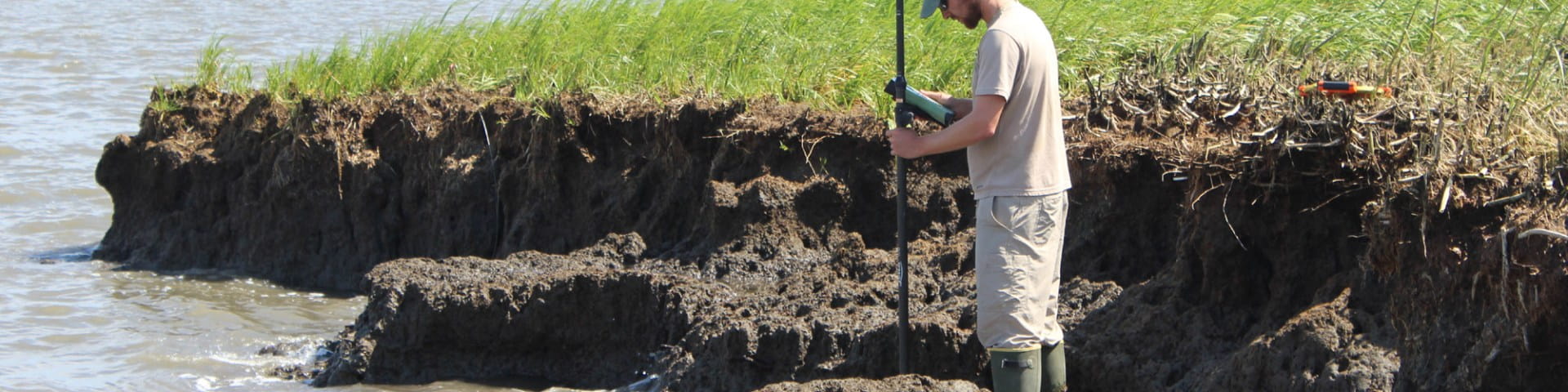
Kirk Raper, the Academy’s wetlands project coordinator, uses an RTK GPS to measure coastline erosion at Bombay Hook National Wildlife Refuge. In recent years, the marsh shoreline has receded as much as 36 feet per year. Credit: Rockwell Geyer
The sweeping Fourth National Climate Assessment, issued Nov. 23 by a consortium of 13 federal agencies, amplifies the already stark warnings described in two previous federal reports in 2014 and 2016. Using the strongest language yet for the federal government, the unequivocal assessment is that climate change is already underway, and many of its long term impacts will be inescapable.
In reading the report, entitled “Impacts, Risks and Adaptation in the United States,” it should be extremely sobering to all of us that so many of the findings of fact are written in the present tense. We’ve italicized the words in the report below to illustrate the point:
- “Earth’s climate is now changing faster than at any point in the history of modern civilization, primarily as a result of human activities.”
- “Observations collected around the world provide significant, clear, and compelling evidence that global average temperature is much higher, and is rising more rapidly, than anything modern civilization has experienced, with widespread and growing impacts.”
- “Across the United States, many regions and sectors are already experiencing the direct effects of climate change. For these communities, climate impacts — from extreme storms made worse by sea level rise, to longer-lasting and more extreme heat waves, to increased numbers of wildfires and floods — are an immediate threat, not a far-off possibility.”
In other words, climate change is not a problem we will face in the future. It is a problem we are dealing with now.
Divided into 30 chapters, the report is a detailed, scientific examination of climate change issues, ranging from the scope and scale of the change itself to its diverse impacts on sectors including agriculture, water supply and the overall economy. It also looks at specific ways that the changing climate will affect different regions. Of special relevance to us in Philadelphia, the report states:
- “High tide flooding has increased by a factor of 10 or more over the last 50 years for many cities in the Northeast region…”
- “Sea level rise (under higher temperature scenarios) will likely increase property losses from hurricanes and other coastal storms for the region by $6–$9 billion per year by 2100, while changes in hurricane activity could raise these estimates to $11–$17 billion per year.”
The National Climate Assessment, mandated by the Global Change Research Act of 1990, comes on the heels of a report issued in October by the United Nations Intergovernmental Panel on Climate Change. That report projected major near-term ecological and economic impacts if average temperatures rise above 1.5 degrees beyond the pre-industrial level. The UN report puts a price tag of inaction at greater than $300 billion, almost half from health-related deaths.
Together these reports have consolidated the best available scientific findings of our present understanding of — and future expectations for — the world’s climate. While scientists will continue to work on this issue far into the future, in terms of guiding practical action the scientific evidence is clear and largely undisputed within the science community.
What then are the practical steps for dealing with such a dire set of reports? The two primary tracks for addressing climate change are mitigation and adaptation.
Adaptation means preparation for the economic, ecological and infrastructure impacts of climate change. Climate impacts in the future will not look like they do in the present. Adaptation must focus on building awareness, planning and implementation to prepare for the expected droughts, flooding, sea level rise and shifting climatic zones. The report recommends a process that adapts to these changes over time.
Mitigation concentrates on reducing emissions of greenhouse gases, such as carbon dioxide. In both case, but especially for mitigation, a key factor will be leadership and political will at all levels — international, national and local — as well as the combined effort of the public and private sectors.
Many of our elected federal officials at the highest level continue to minimize or deny the importance of climate change, even in light of overwhelming evidence, and the U.S. is not participating in international efforts to negotiate reductions in greenhouse gas emissions. It’s hard to overstate the effects this could have for future generations.
Fortunately, a number of cities and states, as well as corporations, have committed to both mitigation and adaptation activities. And as this report demonstrates, professionals in the federal government continue to be guided by sound science and evidence in assessing the current and future state of the climate.
By Roland Wall, Director, Patrick Center for Environmental Research


