Part 1: Front Row to COP21
Journal
Written on: December 28, 2015
In this 3-part series, Carol Collier, a leading authority on watershed management and policy, shares her observations, recommendations and opinions after participating in the recent climate change conference in Paris. Check back later this week for parts 2 and 3.
By Carol R. Collier
Academy Senior Advisor for Watershed Management and Policy, Director of the Environmental Studies and Sustainability Program
After spending an amazing week at the climate change negotiations in Paris (COP21) earlier this month, I wish to share some of my observations and opinions with you.
I attended the first week of the conference as a diplomatic observer, along with three other Drexel University professors. Over the two weeks, seven Drexel professors and one student were able to attend.
The week was kicked off with strongly worded speeches and presentations by many of the ministers and heads of state lead by French President François Hollande and including President Obama. Nearly 200 countries were represented.
Although I didn’t get to see them all, many other celebrities were present to help support the agenda including Paul McCartney advocating for Meatless Monday, Robert Redford, Bill Gates, Arnold Schwarzenegger, Al Gore, Michael Bloomberg, to name a few.
As Secretary of State John Kerry noted, “I don’t think I can remember a time when more than 150 leaders of nations, heads of state have come together in one place for the purpose of furthering an issue of concern to all of them.” He added that climate talks “represent one of the greatest security challenges of the world as well as environmental challenges, as well as energy challenges, as well as health challenges, as well as moral challenges.”
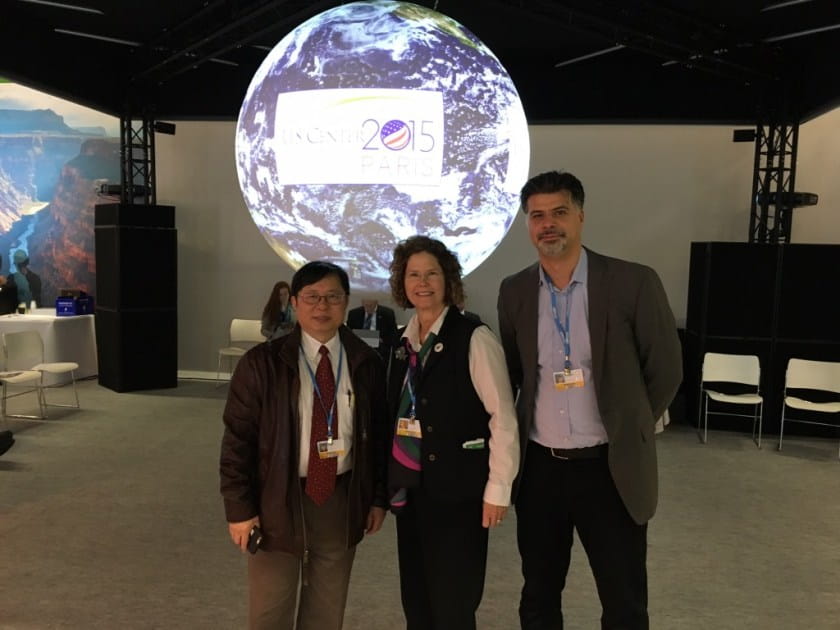
Delegates at the conference (from left): Longjian Liu, associate professor of epidemiology and biostatistics in Drexel’s Dornsife School of Public Health, Carol Collier, and Franco Montalto, Drexel associate professor in the Department of Civil, Architectural and Environmental Engineering.
Most of the negotiation details were worked out in the first week by high level staffers. The agreement had been in development for well over a year, so these were the last of the issues still unresolved. During the second week, the ministers and heads of state returned to resolve the thorniest of issues.
The agreement was signed by 195 countries on Dec. 12. There were major, but voluntary commitments made, including the U.S. pledge to reduce greenhouse gas emissions by 26 to 28 percent, based on 2005 levels, by 2025. And there was the pledge by China to cut emissions by 60 to 65 percent from 2005 levels, with a carbon cap peaking emissions in 2030.
What many people don’t realize is that there was a whole other world at the conference where multiple discussions and presentations were taking place on needs and actions of cities, conditions in the Southern Hemisphere, especially small island nations, forest protection, global economics, occurring impacts to the natural world, transportation, greenhouse gas mitigation, impacts to water resources, to name a few.
Representatives of countries, non-governmental organizations or NGOs, academic institutions, and a limited number from the private sector shared experiences, needs and potential solutions.
There were three levels of engagement:
- High level ministers and negotiators worked through the agreement that will be effective in 2020. It is being developed through a process following the Kyoto Protocol that expires in 2020. Much work had already been completed by individual countries through voluntary commitments known as Intended Nationally Determined Contributions.
- Discussions within the “Blue Zone” where you needed a delegate’s pass. The Drexel delegation was categorized as NGO observers and had access to the Blue Zone, but not the highest levels of the negotiations. There were hundreds of exhibits, country centers, press conferences, organized events (from one hour to all day themed events) and networking areas.
- The Red Zone, outside the more tightly secured Blue Zone. A more low-key, friendlier area with exhibits, meetings and presentations by non-governmental organizations for other NGOs and the public. For instance, there was a very good talk on river basin management and a presentation on birds and how they are “the canary in the mines,” being early indicators of climate change impacts.
Read Part 2 of Carol’s experience here.
To read an earlier blog post before Collier left for the conference, visit this Academy Blog post.


