Climate Change and Me
Journal
Written on: July 21, 2021
The first climate change presentation I saw was back in the 1970s when I was working for the National Weather Service. The speaker, J. Murray Mitchell, was the top climate scientist for NWS.
At the time, media speculation and popular books were suggesting a new “ice age” was coming. While that got the bulk of the publicity, Dr. Mitchell assured us that the warming of the climate would be the biggest problem in the future.
So, when I hear arguments saying: “They were predicting an ice age back in the ’70s,” I know that wasn’t true. I was there.
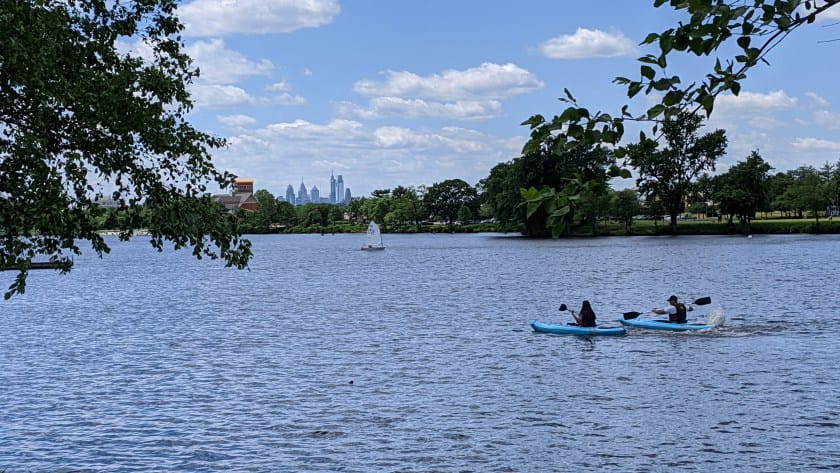
Kayakers journey down the Cooper River at Cooper River Park near Collingswood, N.J. With the Philadelphia area trending towards warmer average temperatures as a result of climate change, it will be important to have ample opportunities for people to stay cool and recreate safely. Photo by Kathryn Christopher
The ’80s took the subject of global warming to the next level. When James Hanson and Al Gore testified about how the warming had already begun, I thought they were exaggerating — a lot. I became an instant skeptic.
I stayed that way until the mid-’90s. The debate about whether the planet was warming or not was “heating up.” Some scientists were interpreting satellite data and were convinced there was no warming.
Then, it was determined that the satellites were wrong — not the ground observations! That was enough for me. I also got to interview Dr. Jerry Mahlman, head of the prestigious Geophysical Fluid Dynamics Laboratory in Princeton. When I asked him about the “debate” he said, “We stopped arguing about that years ago. The science is settled.”
That was in 1996! Yet the deniers continued for another 20-plus years, and a lot of meteorologists (especially those on TV) were in that group. Today, the great majority of climate scientists and meteorologists have accepted the science. Now it’s more about what to do about it.
By Glenn “Hurricane” Schwartz, NBC10 Meteorologist
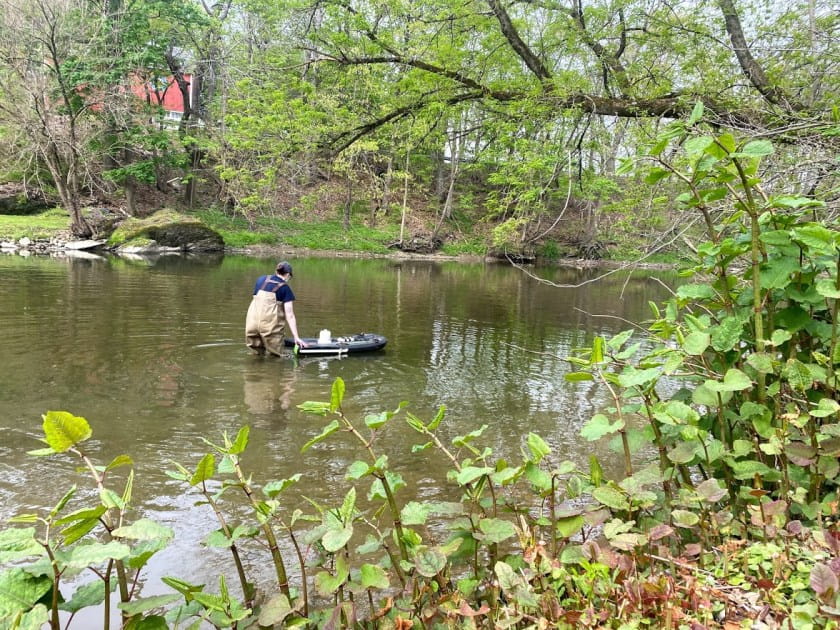
Chemistry co-op Liz Otruba uses a RiverSurveyor to measure depth, flow and rate of discharge of Maiden Creek in Berks County. Climate change affects patterns of precipitation, and Philadelphia is poised to receive more intense downpours, resulting in dangerous flash flooding that impacts the health of freshwater streams as well as harming urban and suburban areas and threatening our sources of clean drinking water. Photo by Melissa Bross
Glenn “Hurricane” Schwartz will be among the panelists at the next Academy Town Square entitled “Preparing for a Warmer, Wetter Philadelphia,” at 7 p.m. Thursday, July 29. He will be joined by Jasmin Velez, community outreach coordinator, Esperanza; Julia Rockwell, manager of the Climate Change Adaptation Program, Philadelphia Water Department; and Mark Sabaj, collection manager of fishes at the Academy. The event is free and available on Zoom. To register, visit the Academy Town Square page here.
Schwartz’s first-hand account above of how the science — and public perception — of climate change has matured during his nearly 50 years of working in meteorology is an insightful perspective as we seek to understand the weather patterns we are experiencing today, and work to mitigate their effects.
We are already starting to see the impacts of global warming. Across the nation, we are experiencing more frequent, more intense extreme weather events like hurricanes and wildfires. Regionally, the Northeast is trending toward wetter summers and milder winters.

NBC 10 meteorologist Glenn “Hurricane” Schwartz
In his 2002 book The Philadelphia Area Weather Book, Schwartz takes readers on another journey through time to let us know what the weather’s been like lately… in a Philadelphia of 2075, after continued decades of global warming.
Is a warmer, wetter Philadelphia really in our “extended forecast?” Read some of Schwartz’s predictions below and prepare your question for the NBC10 meteorologist and his fellow Academy Town Square panelists!
Adapted From The Philadelphia Area Weather Book
A Summary of Philadelphia Weather of 2075
- The year 2075 was another record-setting one in Philadelphia. The average annual temperature was 62.2°F, breaking the previous record of 62.0°F set three years ago. The ten warmest years in Philadelphia history have all occurred since 2050. For comparison, the warmest year of the twentieth century, 1998, had an average temperature of 58.1°F.
- The lowest temperature of the year, 20°F, occurred on January 15. The only big snowstorm of the winter dumped 7 inches of snow before changing to sleet, then rain. Total snow for the season was 15 inches (at the turn of the century, the average was 20 inches).
- Springtime arrived in the Philadelphia area in early March as temperatures reached 80°F on four consecutive days. The last freeze in the city occurred on March 20, and the suburbs were frost free by April 10. The early arrival of spring also brought humid days in April, feeding some drenching thunderstorms at the end of the month.
- The average summer high these days is 87°F, compared to 83°F at the turn of the century. This summer was exceptionally hot with an average of 90°F. There were sixty days (twice as many as at the turn of the century) at 90°F or hotter between April and September. The mercury topped 100°F on five days and there were five nights where the temperature did not fall below 80°F, which coincided with a peak in heat-related casualties at area hospitals.
- This summer, the average dew point was 65°F, about 3°F higher than at the turn of the century. Excessive Heat Warnings for heat indices of 100°F or higher were issued on forty days; heat indices even approached 120°F on two days. Ozone smog pollution reached unhealthy levels on twenty days.
- Summer also brought dry spells, and as usual, water restrictions were mandatory for a few weeks. But when it does rain, it really pours. Three times this summer, torrential thunderstorms dropped between three and six inches of rain, causing flash flooding. These periods of drought interspersed with quick shots of heavy rain have been common in the last few decades and are very disruptive. Overall, summer precipitation averages 13 inches, a slight increase from the average at the turn of the century.
- Hurricane Carl threatened the East Coast in early September. With ocean temperatures over 90°F off the Florida coast, Carl strengthened from a Category-1 with 80-mph winds to a Category-5 with 160-mph winds, in only 36 hours. Category-5 hurricanes that made landfall used to be extremely rare – only two in the United States in the twentieth century – but now the average is about one per decade.
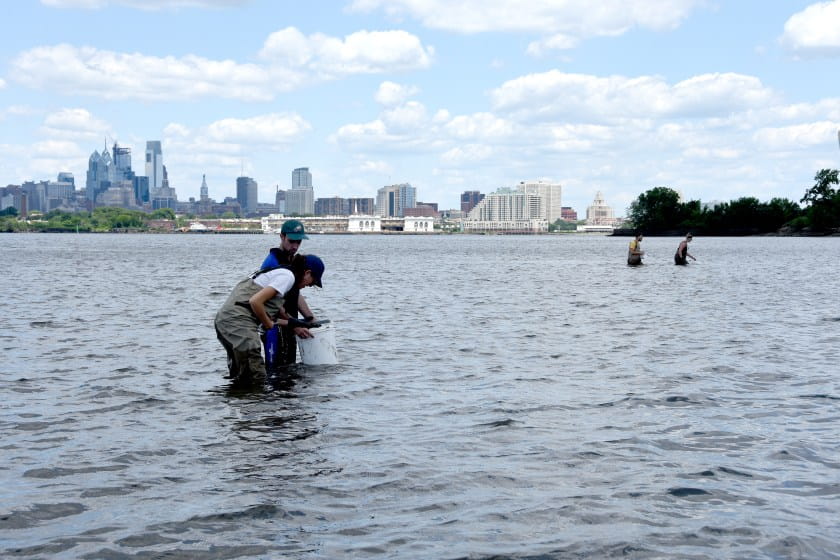
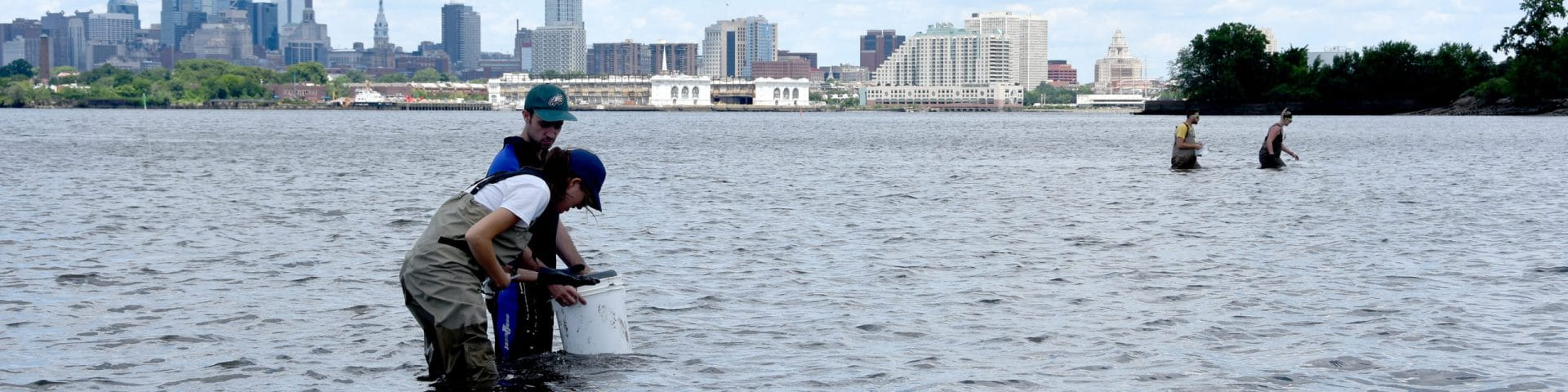
Patrick Center Staff Scientist, Chris Vito (holding bucket) and researchers from the Partnership for the Delaware Estuary collect freshwater mussels on the Delaware River. Higher water temperature and increased sedimentation, both resulting from an uptick in precipitation and flash flooding events due to climate change, will negatively impact vital freshwater habitat for important species like mussels, fish, amphibians and other riverine wildlife and plants. Photo by Roger Thomas
- There were problems at the shore again this summer. Sea-level rise caused by the warming ocean means that there is no beach at high tide at several Jersey and Delaware coast points. These days, even a small storm can produce flooding, and vulnerable areas were inundated time and time again. Higher sea level has also caused more frequent flooding problems in Delaware Bay and increased saltwater intrusion farther up into the Delaware River.
- As has become typical, summer-like temperatures lingered well into September, and even October was pleasantly warm. The first shot of chilly air arrived around Thanksgiving. Christmas was, as in most years, green and brown. But we did have some snow changing to rain for New Year’s Eve, a fitting end to another record warm year.
Compiled by Kathryn Christopher, Academy Manager, Science Communication and Outreach